
<\!-- wp:heading -->
Guillaume Budé\u2019s humanist vision realized through royal patronage and Chalgrin\u2019s architecture
<\!-- /wp:heading --><\!-- wp:paragraph -->
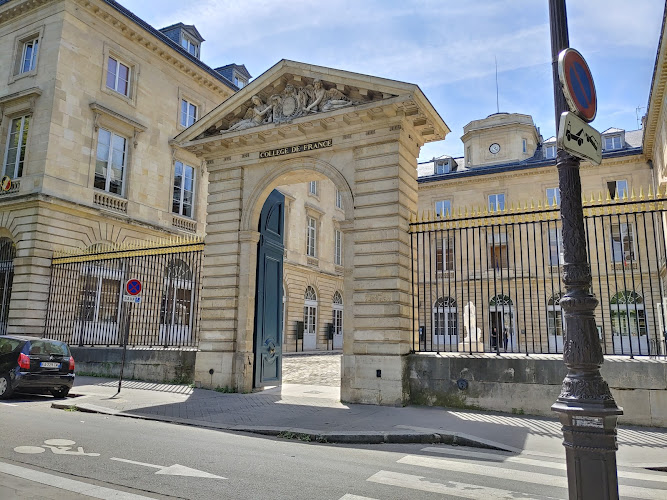
In the heart of the Latin Quarter in the 5th arrondissement, the Collège de France stands as one of the world\u2019s most prestigious research institutions and a monument to the humanist ideals that transformed European education. Founded in 1530 by King Francis I at the urging of Guillaume Budé, this revolutionary institution was conceived as an alternative to the Sorbonne, promoting disciplines like Hebrew, Ancient Greek, and mathematics that challenged traditional university curricula and academic authority.
<\!-- /wp:paragraph --><\!-- wp:paragraph -->
Guillaume Budé\u2019s vision of creating a corps of “royal readers” who could teach freely without university constraints reflected Renaissance humanist belief in the transformative power of knowledge and the importance of returning to original sources in classical languages. This intellectual revolution established the Collège as France\u2019s premier center for cutting-edge research and open education.
<\!-- /wp:paragraph --><\!-- wp:heading {"level":3} -->
Chalgrin\u2019s neoclassical architectural masterpiece
<\!-- /wp:heading --><\!-- wp:paragraph -->
The current building reflects the vision of neoclassical architect Jean-François Chalgrin, who reconstructed the institution from 1774 to 1777. Chalgrin\u2019s design, organized around a court of honor preceded by an elegant gate and portal, creates an environment where architectural dignity enhances intellectual pursuits while maintaining accessibility to the public.
<\!-- /wp:paragraph --><\!-- wp:paragraph -->
The construction of specialized lecture halls and an assembly hall demonstrates Chalgrin\u2019s understanding of how architectural design could serve educational functions, creating spaces that facilitate both intimate instruction and larger academic gatherings. This thoughtful approach to educational architecture influenced university design throughout France and beyond.
<\!-- /wp:paragraph --><\!-- wp:heading {"level":3} -->
Expansion under Letarouilly and institutional growth
<\!-- /wp:heading --><\!-- wp:paragraph -->
Paul-Marie Letarouilly\u2019s expansion from 1837 to 1842, completed in the same architectural style as Chalgrin\u2019s original building, demonstrates how educational institutions can grow while maintaining architectural coherence and historical continuity. This expansion reflected the Collège\u2019s success in fulfilling Budé\u2019s original vision while adapting to evolving academic needs.
<\!-- /wp:paragraph --><\!-- wp:paragraph -->
The consistency of architectural treatment across different construction periods creates a unified institutional identity that reinforces the Collège\u2019s mission while providing functional spaces for France\u2019s most advanced research and education activities.
<\!-- /wp:paragraph --><\!-- wp:heading {"level":3} -->
Democratic education and open intellectual access
<\!-- /wp:heading --><\!-- wp:paragraph -->
The Collège de France\u2019s founding principle—that professors must give lectures where attendance is free and open to anyone—embodies humanist democratic ideals about knowledge as public good rather than elite privilege. This commitment to educational accessibility, maintained for nearly five centuries, demonstrates how great institutions can preserve their founding values while evolving to meet contemporary needs.
<\!-- /wp:paragraph --><\!-- wp:paragraph -->
The institution\u2019s policy of not granting degrees reflects its pure commitment to knowledge advancement and public education rather than credentialing, maintaining Guillaume Budé\u2019s original vision of learning for its own sake rather than for professional qualification.
<\!-- /wp:paragraph --><\!-- wp:heading {"level":3} -->
Contemporary research excellence and cultural influence
<\!-- /wp:heading --><\!-- wp:paragraph -->
Today, the Collège de France maintains its status as France\u2019s most prestigious research establishment, continuing to attract leading scholars across disciplines while preserving its founding commitment to free public education. The institution demonstrates how humanist educational ideals can remain relevant and influential across centuries of social and technological change.
<\!-- /wp:paragraph --><\!-- wp:paragraph -->
For visitors to Paris interested in Renaissance humanism, educational history, or neoclassical architecture, the Collège de France offers an exceptional encounter with Guillaume Budéu2019s revolutionary vision realized through royal patronage and architectural excellence. The institution proves that the finest educational buildings emerge when visionary academic missions inspire architectural solutions that enhance rather than constrain intellectual pursuits, creating environments where human knowledge can flourish across generations.
<\!-- /wp:paragraph -->