
<\!-- wp:heading -->
A tribute to Muslim sacrifice and Maurice Tranchant de Lunel\u2019s Moorish revival masterpiece
<\!-- /wp:heading --><\!-- wp:paragraph -->
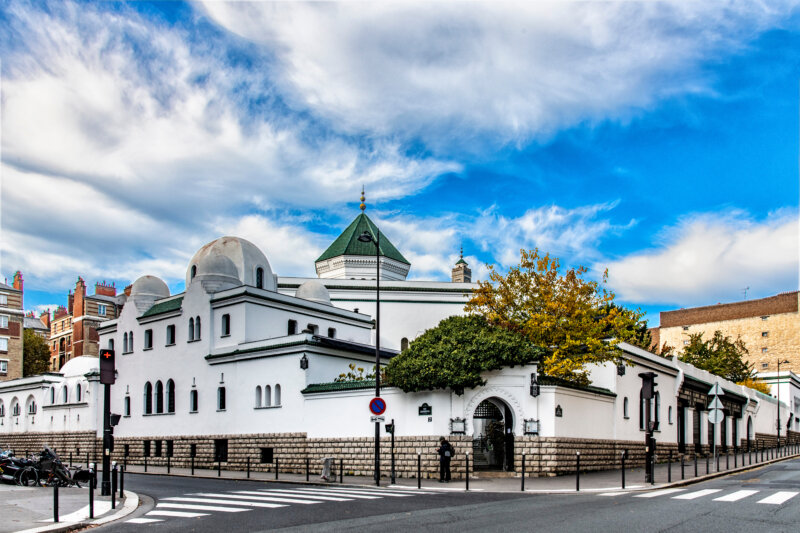
In the 5th arrondissement, the Grande Mosquée de Paris stands as France\u2019s oldest mosque in metropolitan territory and a profound monument to Franco-Islamic friendship and sacrifice. Built between 1922 and 1926 through French state funding mandated by the law of August 19, 1920, this magnificent Moorish Revival complex was conceived to commemorate the thousands of Muslim soldiers who fought and died for France during World War I while symbolizing enduring friendship between France and the Islamic world.
<\!-- /wp:paragraph --><\!-- wp:paragraph -->
Designed by Maurice Tranchant de Lunel, chief of the Beaux-Arts Service in Morocco and director of the Department of Antiquities under Marshal Lyautey, the mosque demonstrates how colonial architectural expertise could create authentic Islamic sacred spaces within European urban contexts while honoring both religious tradition and historical memory.
<\!-- /wp:paragraph --><\!-- wp:heading {"level":3} -->
Moorish Revival architecture inspired by Fez and Tunis
<\!-- /wp:heading --><\!-- wp:paragraph -->
The mosqueu2019s design, executed by architects Robert Fournez, Maurice Mantout, and Charles Heubès following Tranchant de Lunelu2019s plans, draws directly from two of Islamu2019s most significant architectural monuments: the building was modeled after the Al-Qarawiyyin Mosque in Fez, Morocco, one of the worldu2019s oldest mosques, while the 33-meter-tall minaret takes inspiration from the Al-Zaytuna Mosque in Tunisia.
<\!-- /wp:paragraph --><\!-- wp:paragraph -->
This architectural approach demonstrates how colonial experience could inform authentic religious architecture that respected Islamic architectural tradition while adapting to Parisian urban context. Tranchant de Lunel\u2019s expertise in Moroccan architectural heritage enabled the creation of sacred space that achieved both religious authenticity and aesthetic excellence.
<\!-- /wp:paragraph --><\!-- wp:heading {"level":3} -->
Wartime heroism and rescue operations
<\!-- /wp:heading --><\!-- wp:paragraph -->
During World War II, the mosque\u2019s rector, Si Kaddour Benghabrit, transformed the institution into a center of resistance by issuing fake passports and certificates of Muslim identity to Jewish families and resistance fighters. These courageous actions, estimated to have saved up to 1,600 lives, demonstrate how religious institutions can serve broader humanitarian purposes while honoring their spiritual missions.
<\!-- /wp:paragraph --><\!-- wp:paragraph -->
This wartime heroism reflects the mosque\u2019s founding ideals of Franco-Islamic cooperation and mutual support, proving that institutions created to commemorate sacrifice can inspire ongoing acts of courage and compassion when faced with new moral challenges.
<\!-- /wp:paragraph --><\!-- wp:heading {"level":3} -->
Cultural complex and community services
<\!-- /wp:heading --><\!-- wp:paragraph -->
The mosque complex encompasses more than religious space, including a library, meeting and study rooms, traditional restaurant serving Moroccan cuisine, tea room, and hammam baths that provide comprehensive cultural and social services for Paris\u2019s Muslim community while welcoming visitors interested in Islamic culture and traditions.
<\!-- /wp:paragraph --><\!-- wp:paragraph -->
This multifunctional approach reflects the mosque\u2019s original conception as a Muslim Institute that could serve educational, cultural, and social functions while maintaining its essential religious purpose, creating a model for how religious institutions can contribute to broader urban cultural life.
<\!-- /wp:paragraph --><\!-- wp:heading {"level":3} -->
Symbol of religious tolerance and cultural bridge
<\!-- /wp:heading --><\!-- wp:paragraph -->
The peaceful coexistence of the mosque with its Latin Quarter neighbors demonstrates French commitment to religious diversity and cultural tolerance within the broader context of Parisian intellectual and cultural life. The mosque\u2019s gardens and courtyard provide tranquil spaces that enhance rather than isolate the institution from its urban environment.
<\!-- /wp:paragraph --><\!-- wp:paragraph -->
For visitors to Paris interested in Islamic architecture, interfaith relations, or the complex history of French colonialism and immigration, the Grande Mosquée offers an exceptional encounter with authentic Islamic sacred architecture and ongoing Muslim community life. The mosque proves that religious buildings can serve both spiritual and cultural bridge functions, creating spaces where different traditions can meet, interact, and enrich each other while maintaining their distinctive identities and values.
<\!-- /wp:paragraph -->