
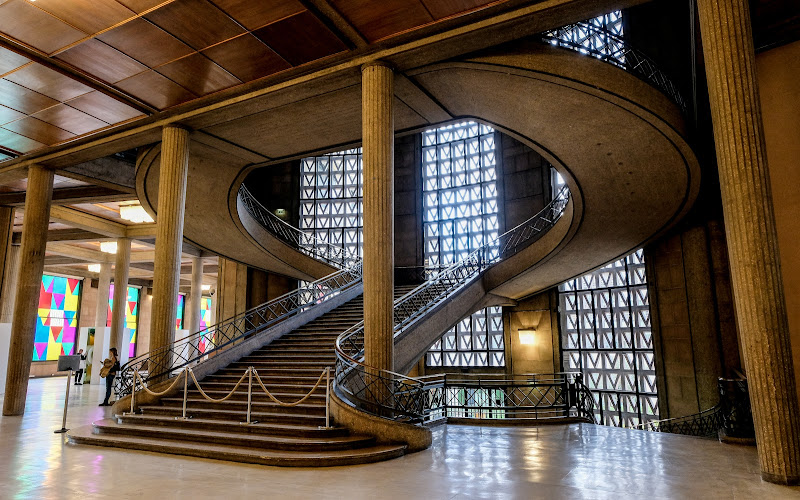
Perret’s concrete temple where democracy meets architectural innovation
In the 16th arrondissement, the Palais d’Iéna stands as Auguste Perret’s 1937 masterpiece in exposed concrete architecture, where reinforced concrete construction created one of three permanent buildings surviving from the Universal Exhibition that demonstrated how innovative building materials could serve democratic institutions through design that honored ancient Greek architectural principles while embracing modern construction techniques. Serving as headquarters for the Conseil économique, social et environnemental (CESE)—France’s third assembly of the Republic—this extraordinary palace proves how exceptional architectural vision can serve both immediate governmental functionality and long-term cultural education through public buildings that embody democratic values within innovative structural systems that influence international architectural development.
Democratic architecture and republican symbolism
Exposed concrete innovation and Greek classical inspiration
Architectural education and construction mastery
Universal Exhibition legacy and cultural accessibility
Essential information
- Architect: Auguste Perret (concrete construction pioneer)
- Construction: 1937 (1937 Universal Exhibition)
- Location: 16th arrondissement, near Eiffel Tower
- Current function: CESE (Conseil économique, social et environnemental)
- Architectural style: Exposed concrete with Greek classical references
- Structural elements: Over 100 columns, rounded ends
- Famous staircase: Double-revolution heart-shaped design
- Public access: Free guided tours Monday-Friday
Architectural and governmental significance
- Democratic symbolism: Republican architecture serving citizen consultation
- Construction innovation: Reinforced concrete achieving classical proportions
- Assembly space: 25-meter diameter hemicycle for 175 CESE members
- Monumental spaces: 60-meter hypostyle hall with fluted columns
- Educational legacy: Staircase famous in architecture schools worldwide
Concrete innovation serves democratic governance excellence
The Palais d’Iéna embodies the successful integration of architectural innovation with democratic governance, where Auguste Perret’s pioneering reinforced concrete construction created governmental buildings that honor both classical republican tradition and contemporary construction possibilities through design that serves French democratic institutions while influencing international development of public architecture serving republican governance needs. This remarkable palace proves that exceptional governmental architecture emerges when innovative construction techniques meet democratic institutional requirements, creating public buildings that serve both immediate governmental functionality and long-term cultural education about the relationship between architectural excellence and republican governance requiring spaces that embody both historical wisdom and contemporary innovation. For concrete architecture enthusiasts, democratic institution admirers, or anyone interested in how architectural innovation can serve republican governance, this exposition-era palace offers an extraordinary encounter with construction excellence, where Greek-inspired concrete columns and impossible staircases demonstrate the technical mastery required to create governmental buildings that honor both classical proportions and modern engineering possibilities, proving that the finest public architecture achieves lasting significance through ongoing democratic service rather than mere architectural preservation, creating spaces where republican governance continues operating within environments that inspire both governmental effectiveness and citizen appreciation for architectural innovation serving ongoing democratic mission within concrete construction that proves modern materials can achieve classical dignity while serving contemporary republican institutions requiring both functional efficiency and cultural inspiration.