
<\!-- wp:heading -->
From royal grandeur to revolutionary tragedy to republican reconciliation
<\!-- /wp:heading --><\!-- wp:paragraph -->
At the eastern terminus of the Champs-Élysées in the 8th arrondissement, Place de la Concorde commands 7.6 hectares as Paris\u2019s largest public square and one of its most historically charged spaces. Originally conceived as Place Louis XV to showcase Ange-Jacques Gabriel\u2019s architectural vision and Edmé Bouchardon\u2019s equestrian statue of the Sun King, this octagonal square has witnessed the full spectrum of French political transformation from royal celebration to revolutionary terror to republican reconciliation.
<\!-- /wp:paragraph --><\!-- wp:paragraph -->
Gabriel\u2019s winning competition design, approved in 1755, created a moat-skirted octagon with cut-off corners that provided appropriate surroundings for royal commemoration while establishing one of Europe\u2019s finest examples of 18th-century urban planning. The completion of Bouchardon\u2019s bronze statue in 1763 marked the fulfillment of this royal vision, creating a ceremonial space worthy of absolute monarchy\u2019s grandest ambitions.
<\!-- /wp:paragraph --><\!-- wp:heading {"level":3} -->
Revolutionary transformation and the machinery of terror
<\!-- /wp:heading --><\!-- wp:paragraph -->
The French Revolution transformed the square from celebration to condemnation when it was renamed Place de la Révolution and became the primary site for public executions. Of the 2,498 persons guillotined in Paris during the Revolution, 1,119 met their fate on this square, including Louis XVI, Marie Antoinette, and ultimately Maximilien Robespierre himself.
<\!-- /wp:paragraph --><\!-- wp:paragraph -->
This concentration of revolutionary justice on the former royal square created a powerful symbolic inversion—the space once dedicated to royal glorification became the stage for royal destruction and popular sovereignty. The guillotine\u2019s placement where Louis XV\u2019s statue once stood demonstrated revolutionary determination to erase monarchical memory through public spectacle.
<\!-- /wp:paragraph --><\!-- wp:heading {"level":3} -->
The Luxor Obelisk and diplomatic reconciliation
<\!-- /wp:heading --><\!-- wp:parameter --><\!-- wp:paragraph -->
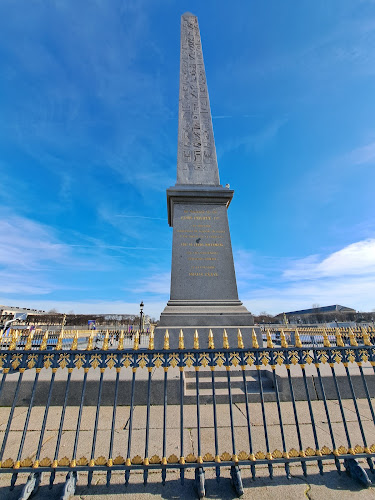
The installation of the Luxor Obelisk in 1836 represented a masterstroke of political symbolism and diplomatic grace. This 3,300-year-old monument to Pharaoh Ramesses II, gifted by Egyptian leader Muhammad Ali Pasha in 1829, provided a neutral centerpiece that honored no particular French political faction while adding ancient grandeur to the revolutionary square.
<\!-- /wp:paragraph --><\!-- wp:paragraph -->
Rising 23 meters and weighing over 250 tonnes, the yellow granite obelisk was dedicated by King Louis-Philippe on October 25, 1836, marking the square\u2019s transformation into Place de la Concorde. The choice of an ancient Egyptian monument demonstrated France\u2019s growing interest in archaeology and orientalism while providing a unifying symbol that transcended domestic political divisions.
<\!-- /wp:paragraph --><\!-- wp:heading {"level":3} -->
Gabriel\u2019s architectural framework and Hittorff\u2019s completion
<\!-- /wp:heading --><\!-- wp:paragraph -->
Gabriel\u2019s original design included two matching buildings flanking rue Royale—now the Hôtel de la Marine and Hôtel de Crillon—which demonstrate 18th-century French architectural excellence and urban design sophistication. Around the square\u2019s periphery, eight giant pedestals support statues representing provincial capitals: Lille, Strasbourg, Lyon, Marseille, Bordeaux, Nantes, Brest, and Rouen.
<\!-- /wp:paragraph --><\!-- wp:parameter --><\!-- wp:paragraph -->
Jacques Ignace Hittorff\u2019s appointment as chief architect in 1832 brought the square to completion with two fountains complementing the obelisk, installed after 1836. The 1998 addition of a gold-leafed pyramidal cap, replacing the original believed stolen in the 6th century BC, demonstrates ongoing care for this ancient monument within its Parisian setting.
<\!-- /wp:paragraph --><\!-- wp:heading {"level":3} -->
Confluence of history and contemporary urban life
<\!-- /wp:heading --><\!-- wp:paragraph -->
Today, Place de la Concorde serves as both a transportation hub and a ceremonial space where French history remains palpably present. The squareu2019s position linking the Champs-Élysées to the Tuileries Gardens places it at the heart of Parisian urban circulation while its monuments maintain connection to the dramatic events that shaped modern France.
<\!-- /wp:paragraph --><\!-- wp:paragraph -->
For visitors to Paris, the square offers a unique opportunity to experience the layered complexity of French history—royal grandeur, revolutionary violence, imperial diplomacy, and republican reconciliation—all synthesized within Gabriel\u2019s elegant architectural framework. The ancient Egyptian obelisk, standing where both royal statue and revolutionary guillotine once occupied center stage, embodies the French capacity for transformation while honoring the permanence of great civilizations. Place de la Concorde demonstrates how public spaces can absorb and transcend even the most traumatic historical events to serve new generations as gathering places for shared civic life.
<\!-- /wp:paragraph -->