
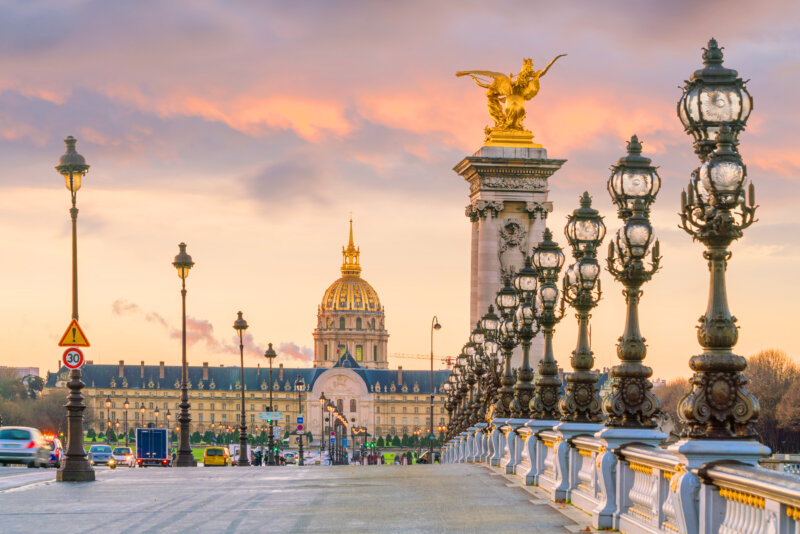
Pont Alexandre-III
Pont Alexandre III is a Paris Attractions landmark located in the 7 arrondissement. The gilded masterpiece symbolizing Franco-Russian friendship and Belle Époque grandeur Spanning the Seine between the 7th and 8th arrondissements, Pont Alexandre III stands as Paris\u2019s most ornate bridge and a shimmering testament to Belle Époque diplomatic artistry. Built between 1896 and 1900 […]
Pont Alexandre III is a Paris Attractions landmark located in the 7 arrondissement.
<\!-- wp:heading -->
The gilded masterpiece symbolizing Franco-Russian friendship and Belle Époque grandeur
<\!-- /wp:heading --><\!-- wp:paragraph -->
Spanning the Seine between the 7th and 8th arrondissements, Pont Alexandre III stands as Paris\u2019s most ornate bridge and a shimmering testament to Belle Époque diplomatic artistry. Built between 1896 and 1900 for the Paris Exposition Universelle, this magnificent single-span steel arch was conceived as a permanent monument to the Franco-Russian Alliance of 1892, transforming international diplomacy into architectural splendor that continues to captivate visitors over a century later.
<\!-- /wp:paragraph --><\!-- wp:paragraph -->
Named after Tsar Alexander III of Russia, who concluded the diplomatic alliance, the bridge gained profound symbolic weight when his son, Tsar Nicholas II, personally laid the first stone in 1896. This imperial ceremony demonstrated how architecture could serve diplomatic purposes while creating lasting monuments to international cooperation and friendship.
<\!-- /wp:paragraph --><\!-- wp:heading {"level":3} -->
Engineering marvel and Beaux-Arts magnificence
<\!-- /wp:heading --><\!-- wp:paragraph -->
The bridge represents a remarkable feat of 19th-century engineering through its single 6-meter-high steel arch span that eliminates intermediate supports, creating unobstructed navigation for Seine river traffic while achieving unprecedented architectural elegance. This engineering solution demonstrates how technical innovation could serve both practical transportation needs and aesthetic ambitions.
<\!-- /wp:paragraph --><\!-- wp:paragraph -->
The Beaux-Arts style decoration, featuring exuberant Art Nouveau lamps, cherubs, nymphs, and winged horses, was created by leading artists of the period who understood how ornamental art could transform utilitarian infrastructure into cultural landmarks that embody national values and international relationships.
<\!-- /wp:paragraph --><\!-- wp:heading {"level":3} -->
Symbolic sculpture program celebrating alliance
<\!-- /wp:heading --><\!-- wp:paragraph -->
The bridge\u2019s elaborate sculptural program systematically celebrates Franco-Russian friendship through carefully orchestrated iconography. The four massive stone pillars are crowned with gilded bronze sculptures known as the “Fames”—winged female figures restraining Pegasus that symbolize artistic inspiration controlled by diplomatic wisdom.
<\!-- /wp:paragraph --><\!-- wp:paragraph -->
The nymph reliefs at the arch centers over the Seine create direct memorials to the alliance: upstream, Nymphs of the Seine surround Paris\u2019s arms, while downstream, Neva River nymphs accompany Russia\u2019s gilded imperial arms. This systematic iconographic program transforms crossing the bridge into a journey through diplomatic symbolism and cultural exchange.
<\!-- /wp:paragraph --><\!-- wp:heading {"level":3} -->
Strategic urban connections and cultural vistas
<\!-- /wp:heading --><\!-- wp:parameter --><\!-- wp:paragraph -->
The bridgeu2019s strategic position connects the Champs-Élysées quarter with the Invalides and Eiffel Tower districts, creating one of Parisu2019s most spectacular urban vistas. This placement ensures that crossing the bridge provides panoramic views of major Parisian landmarks while serving essential transportation functions that connect diverse cultural and commercial districts.
<\!-- /wp:paragraph --><\!-- wp:parameter --><\!-- wp:paragraph -->
The bridge\u2019s integration with the Grand Palais and Petit Palais, also built for the 1900 exposition, creates a comprehensive Belle Époque architectural ensemble that demonstrates how infrastructure projects can enhance rather than disrupt historical urban fabric while serving contemporary cultural and transportation needs.
<\!-- /wp:paragraph --><\!-- wp:heading {"level":3} -->
Resilience and restoration heritage
<\!-- /wp:heading --><\!-- wp:parameter --><\!-- wp:paragraph -->
The bridge\u2019s survival through two world wars, including significant damage during World War II, followed by careful restoration that preserved its original gilded splendor, demonstrates French commitment to maintaining architectural heritage that embodies important historical relationships and cultural values.
<\!-- /wp:paragraph --><\!-- wp:parameter --><\!-- wp:paragraph -->
The successful restoration efforts ensured that subsequent generations could continue experiencing the bridge\u2019s role as both functional infrastructure and cultural monument, proving that great architecture can withstand historical upheavals while maintaining its essential character and symbolic significance.
<\!-- /wp:paragraph --><\!-- wp:heading {"level":3} -->
Eternal symbol of diplomatic architecture
<\!-- /wp:heading --><\!-- wp:parameter --><\!-- wp:paragraph -->
Today, Pont Alexandre III continues to serve its original dual purpose as essential Seine crossing and beloved cultural landmark that attracts millions of visitors annually. The bridge demonstrates how diplomatic architecture can transcend its original political context to become universal symbol of artistic excellence and international cooperation.
<\!-- /wp:parameter --><\!-- wp:parameter --><\!-- wp:paragraph -->
For visitors to Paris interested in Belle Époque architecture, diplomatic history, or engineering achievement, Pont Alexandre III offers an unparalleled experience where ornamental artistry enhances functional infrastructure while celebrating the optimistic internationalism that characterized the best aspects of early 20th-century European culture. The bridge proves that the finest civic architecture emerges when practical necessity inspires artistic imagination in service of cultural values that transcend national boundaries.
<\!-- /wp:paragraph -->