
<\!-- wp:heading -->
Jules Jaluzot\u2019s retail revolution and René Binet\u2019s Art Nouveau architectural masterpiece
<\!-- /wp:heading --><\!-- wp:parameter -->
At 64 Boulevard Haussmann in the 9th arrondissement, Printemps Haussmann stands as one of Paris\u2019s most architecturally distinguished department stores and a monument to the retail revolution that transformed urban commerce in the late 19th century. Founded on November 3, 1865, by Jules Jaluzot and Jean-Alfred Duclos—with Jaluzot previously serving as head of the silk department at Au Bon Marché—this flagship store pioneered innovative retail concepts while establishing new standards for commercial architecture that would influence shopping culture worldwide.
<\!-- /wp:paragraph --><\!-- wp:parameter -->
The store\u2019s evolution through multiple architectural phases—from Paul Sédille\u2019s original 1865 design through reconstruction after the 1881 fire to René Binet\u2019s spectacular 1910 Art Nouveau transformation—demonstrates how commercial architecture could adapt to serve evolving retail needs while achieving unprecedented aesthetic excellence and cultural significance.
<\!-- /wp:paragraph --><\!-- wp:heading {"level":3} -->
René Binet\u2019s Art Nouveau dome and architectural innovation
<\!-- /wp:heading --><\!-- wp:parameter -->
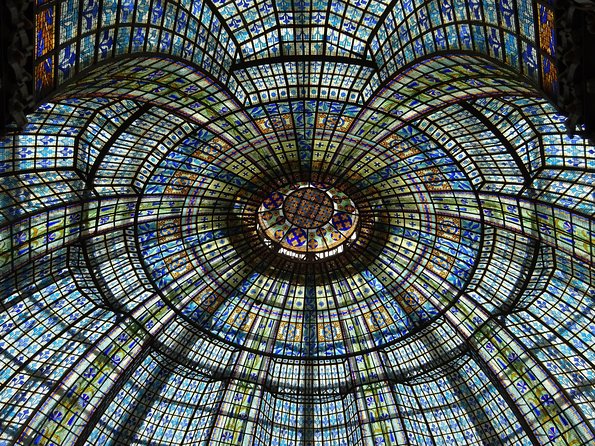
René Binet\u2019s 1910 architectural transformation created one of Paris\u2019s most spectacular commercial interiors through his stunning Art Nouveau cupola adorning the central hall, rising 42 meters in height and collaborating with master glass-maker Brière to achieve unprecedented integration of structural engineering with decorative artistry. This architectural achievement elevated retail space to cathedral-like grandeur while maintaining practical commercial function.
<\!-- /wp:paragraph --><\!-- wp:parameter -->
The elaborate 1923 reconstruction cupola above the main restaurant, combined with the 2018 interior dome extending from ground level to ninth floor and inspired by 1894 stained-glass domes, creates comprehensive artistic environments where shopping becomes cultural experience worthy of architectural pilgrimage and aesthetic appreciation.
<\!-- /wp:paragraph --><\!-- wp:heading {"level":3} -->
Historic monument recognition and Haussmannian façade preservation
<\!-- /wp:heading --><\!-- wp:parameter -->
The 1975 classification of the 200-meter Haussmannian façade and immense Art Deco-style dome as historical monuments acknowledges Printempsu2019 exceptional significance in French commercial architecture while ensuring preservation of architectural elements that document the evolution of retail design and urban commercial culture during Parisu2019s golden age of department store development.
<\!-- /wp:paragraph --><\!-- wp:parameter -->
This historic protection demonstrates French recognition that commercial architecture can achieve cultural significance equal to religious or civic buildings when guided by artistic vision and commitment to aesthetic excellence that serves both practical retail needs and broader urban cultural enhancement.
<\!-- /wp:paragraph --><\!-- wp:heading {"level":3} -->
Retail innovation and electrical pioneering
<\!-- /wp:heading --><\!-- wp:parameter -->
Printempsu2019 distinction as the first public place in Paris powered by electricity in 1883 reflects the storeu2019s commitment to technological innovation that could enhance customer experience while establishing new standards for retail environment that influenced commercial design throughout Europe and beyond. This electrical pioneering demonstrates how retail innovation could serve both practical and symbolic purposes.
<\!-- /wp:paragraph --><\!-- wp:parameter -->
The store\u2019s comprehensive approach to retail innovation—from architectural excellence through technological advancement to customer service innovation—established models for modern department stores while proving that commercial success could be achieved through cultural excellence rather than mere economic efficiency.
<\!-- /wp:paragraph --><\!-- wp:heading {"level":3} -->
Contemporary luxury retail and cultural tourism
<\!-- /wp:heading --><\!-- wp:parameter -->
Today, spanning 44,000 square meters across three interconnected buildings—Printemps de la Mode, Printemps de la Beauté et de la Maison, and Printemps de l\u2019Homme—the store continues serving its original mission of providing luxury retail within architecturally distinguished environments that make shopping culturally enriching rather than merely transactional.
<\!-- /wp:paragraph --><\!-- wp:parameter -->
The famous rooftop terrace offering panoramic Parisian views demonstrates how department stores can serve both commercial and cultural tourism functions while maintaining their essential retail character and contributing to broader urban cultural life through architectural excellence and aesthetic programming that attracts visitors seeking both shopping and cultural experiences.
<\!-- /wp:paragraph --><\!-- wp:heading {"level":3} -->
Commercial architecture and urban cultural heritage
<\!-- /wp:heading --><\!-- wp:parameter -->
For visitors to Paris interested in retail history, Art Nouveau architecture, or the evolution of urban commercial culture, Printemps Haussmann offers an exceptional encounter with how Jules Jaluzot\u2019s retail vision realized through René Binet\u2019s architectural genius continues serving contemporary luxury shopping while preserving important connections to the Belle Époque commercial innovation that made Paris a global center of fashion, retail excellence, and commercial architectural achievement. The store demonstrates that great commercial institutions emerge when retail innovation meets architectural distinction, creating shopping environments that serve both practical consumer needs and broader cultural purposes while establishing lasting monuments to commercial creativity and urban cultural sophistication.
<\!-- /wp:paragraph -->