
<\!-- wp:heading -->
The oldest great synagogue in Paris and a monument to Ashkenazi resilience
<\!-- /wp:heading --><\!-- wp:paragraph -->
At 15 rue Notre-Dame-de-Nazareth in the 3rd arrondissement, the Synagogue Nazareth stands as Paris\u2019s oldest great synagogue and a testament to the perseverance and cultural vitality of the city\u2019s Ashkenazi Jewish community. Built in 1822 after the community acquired land in 1819 between Rue Neuve-Saint-Laurent and Rue Notre-Dame-de-Nazareth, this historic synagogue represents the first permanent expression of Jewish religious architecture in post-revolutionary Paris and the foundation of organized Jewish communal life in the modern French capital.
<\!-- /wp:paragraph --><\!-- wp:paragraph -->
The synagogue\u2019s evolution from its original 1822 construction through its 1850 reconstruction demonstrates both the challenges faced by 19th-century Jewish communities and their determination to create lasting religious institutions that could serve growing populations while achieving architectural distinction worthy of their spiritual and cultural significance.
<\!-- /wp:paragraph --><\!-- wp:heading {"level":3} -->
Rothschild patronage and architectural reconstruction
<\!-- /wp:heading --><\!-- wp:parameter --><\!-- wp:paragraph -->
When the original building threatened collapse in 1850, Baron James de Rothschild\u2019s generous donations enabled complete reconstruction under architect Alexandre Thierry\u2019s direction, replacing Sandrié de Jouy\u2019s original 1822 design. This reconstruction demonstrates how philanthropic leadership could ensure community religious architecture achieved both structural stability and aesthetic excellence appropriate to sacred purposes.
<\!-- /wp:paragraph --><\!-- wp:parameter --><\!-- wp:paragraph -->
Rothschild\u2019s patronage reflects broader patterns of 19th-century Jewish community development, where successful individuals invested in communal institutions that could serve both immediate religious needs and broader cultural advancement while establishing permanent Jewish presence within French urban culture.
<\!-- /wp:paragraph --><\!-- wp:heading {"level":3} -->
Neo-Moorish architecture and Jewish symbolic elements
<\!-- /wp:heading --><\!-- wp:parameter --><\!-- wp:paragraph -->
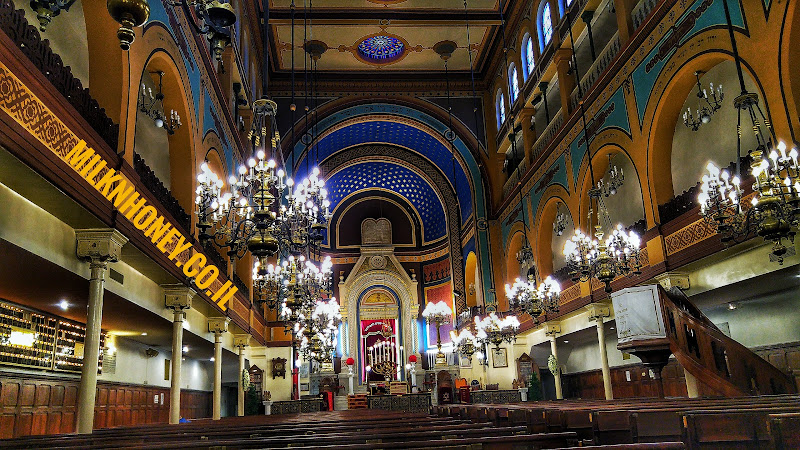
The synagogue\u2019s neo-Moorish style, accommodating up to 1,200 worshippers, creates sacred spaces that honor both Sephardic architectural traditions and contemporary French aesthetic sensibilities. The imposing façade\u2019s rose window with central Star of David provides immediately recognizable Jewish identity while maintaining architectural harmony with surrounding Parisian buildings.
<\!-- /wp:paragraph /><\!-- wp:parameter --><\!-- wp:paragraph -->
The interior\u2019s twelve stained-glass windows symbolizing the twelve tribes of Israel, restored to original condition around 2000, create comprehensive Jewish iconographic programs that enhance liturgical function while educating worshippers about Jewish historical and spiritual traditions through architectural symbolism and artistic beauty.
<\!-- /wp:paragraph --><\!-- wp:heading {"level":3} -->
Chief Rabbi seat and institutional significance
<\!-- /wp:heading --><\!-- wp:parameter --><\!-- wp:paragraph -->
The synagogue\u2019s role as the official seat of the chief rabbi of Paris since 1874 establishes its central importance in French Jewish religious authority and community organization. This institutional function demonstrates how individual synagogues can serve broader community leadership needs while maintaining their essential congregational and liturgical purposes.
<\!-- /wp:paragraph /><\!-- wp:parameter --><\!-- wp:paragraph -->
The inclusion of an organ, following European great synagogue traditions, reflects the community\u2019s integration of musical excellence with Jewish liturgical practice, demonstrating how synagogue architecture and programming could embrace both traditional Jewish worship and contemporary musical culture.
<\!-- /wp:paragraph --><\!-- wp:heading {"level":3} -->
Historic monument status and Jewish heritage preservation
<\!-- /wp:heading --><\!-- wp:parameter --><\!-- wp:paragraph -->
The synagogue\u2019s classification as a historical monument acknowledges both its architectural significance and its crucial role in documenting Jewish presence and contribution to Parisian cultural life. This recognition ensures preservation of neo-Moorish architectural elements while supporting the building\u2019s continued function as active center of Jewish religious and community life.
<\!-- /wp:paragraph /><\!-- wp:parameter --><\!-- wp:paragraph -->
Today, the Synagogue Nazareth continues to serve Paris\u2019s Jewish community while standing as a monument to Jewish resilience, architectural achievement, and cultural integration within French society. For visitors interested in Jewish heritage, 19th-century religious architecture, or the multicultural development of modern Paris, the synagogue offers an exceptional encounter with how immigrant communities can create lasting religious institutions that honor both traditional identity and integration within broader urban culture. The synagogue demonstrates that great religious architecture emerges when community determination meets architectural vision, creating sacred spaces that serve both immediate spiritual needs and broader cultural purposes while contributing to the rich diversity that defines contemporary Parisian life.
<\!-- /wp:paragraph -->