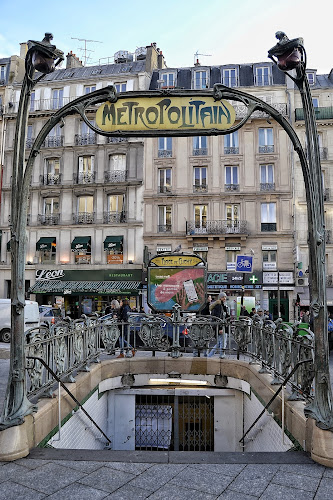
At Place de Clichy in the 18th arrondissement stands one of Paris’s most elegant examples of functional Art Nouveau design—a Hector Guimard metro entrance. These iconic subway entrances transformed everyday urban infrastructure into works of art, making the simple act of entering the metro an aesthetic experience that defined the Belle Époque spirit.
## Hector Guimard: The Metro’s Art Nouveau Visionary
Between 1900 and 1913, architect Hector Guimard revolutionized Paris public transportation design. When the city opened its first metro line, officials initially held a competition for entrance designs. However, Adrien Benard, president of the Conseil Municipal de Paris, bypassed the winners and chose Guimard—a decision that would create one of Paris’s most recognizable architectural signatures.
Guimard’s proposal was radical: instead of traditional masonry structures, he designed cast iron and glass entrances that were lighter, cheaper, faster to produce, and required less street space. This practical innovation allowed for the fluid, organic forms that became the hallmark of “Style Métro.”
## The Art of Functional Beauty
Guimard’s metro entrances demonstrate how Art Nouveau principles could transform utilitarian infrastructure. The cast iron structures, painted in a distinctive green reminiscent of oxidized brass, feature sinuous curves that seem to grow organically from the sidewalk. The flowing lines and botanical motifs create an impression of natural growth rather than mechanical construction.
The Place de Clichy entrance showcases Guimard’s mastery of the “entourage” style—an unroofed enclosure that frames the station entrance without overwhelming the streetscape. The signature elements include:
– **Sinuous stalks:** The iconic curved supports that rise like plant stems
– **Globe luminaires:** Red-orange lighting fixtures that evoke flowers or eyes
– **Métropolitain signage:** The flowing lettering that Guimard specifically designed
– **Organic ironwork:** Cast iron details that mirror natural forms
## Three Types of Guimard Magic
Guimard created three distinct entrance types, each suited to different urban contexts:
1. **Édicules (Kiosks):** Elaborate glass-roofed structures nicknamed “libellules” (dragonflies) for their wing-like canopies. Only two originals survive at Porte Dauphine and Abbesses.
2. **Entourages (Enclosures):** The most common type, featuring unroofed cast iron frameworks that elegantly define the entrance space without blocking views or light.
3. **Pavilions:** Free-standing structures with waiting rooms, influenced by Japanese pagoda architecture, built at major stations like Bastille and Étoile.
## Engineering Elegance
The genius of Guimard’s design lay in solving practical problems through beautiful forms. Cast iron set in concrete allowed for mass production while maintaining artistic integrity. The material choice enabled the characteristic curved forms impossible with stone, while the green patina finish unified the entrances across the city.
Each entrance required careful consideration of its specific location—the designs had to accommodate varying street widths, traffic patterns, and architectural contexts while maintaining the distinctive Art Nouveau aesthetic that made them instantly recognizable as metro access points.
## Cultural Impact and Recognition
Guimard’s metro entrances became more than functional infrastructure—they established a new visual identity for Paris that influenced Art Nouveau movements worldwide. The “Style Métro” represented modernity, sophistication, and the seamless integration of art into daily life.
Of the original 154 entrances, 86 survive today, all protected as historical monuments since 1978. These remaining entrances serve as time capsules of Belle Époque Paris, when the city embraced the idea that even subway entrances could be works of art.
## The Place de Clichy Experience
**Location:** Place de Clichy, 75018 Paris
**Metro:** Lines 2 and 13
**Style:** Art Nouveau entourage design
**Best Viewing:** Evening when the globe lights illuminate the ironwork
Visiting the Place de Clichy entrance offers more than metro access—it provides a moment to appreciate how visionary design can elevate everyday urban experiences. The flowing lines and organic forms create a brief artistic interlude in the city’s rhythm, a reminder that beauty and function can coexist perfectly.
## Legacy of Urban Artistry
The Guimard metro entrances at Place de Clichy and throughout Paris demonstrate how thoughtful design can transform utilitarian infrastructure into cultural landmarks. They represent a unique moment when a city committed to making beauty accessible to everyone, every day.
Today, these entrances continue to welcome millions of passengers while serving as ambassadors for Art Nouveau design. They prove that truly great architecture doesn’t just shelter human activity—it elevates the human spirit through the simple act of creating beauty in unexpected places.