
White-robed monks\ legacy in the heart of the Marais
At 12 rue des Blancs-Manteaux in the heart of the historic Marais, Église Notre-Dame-des-Blancs-Manteaux stands as a fascinating architectural palimpsest where eight centuries of religious history create layers of meaning and beauty. Originally established in 1258 by the Servite order known for their distinctive white woolen robes, this remarkable church has survived monastic suppression, revolutionary destruction, and urban transformation to emerge as a unique fusion of medieval origins, baroque reconstruction, and neoclassical enhancement.
The White Coats and medieval foundation
The church owes its distinctive name to the Servants of Mary (Serfs de Marie), a begging order that established their monastery here in 1258. French Parisians nicknamed these monks “les Blancs-Manteaux” (the White Coats) because of their characteristic white woolen habits, creating a popular designation that outlasted the order itself and became permanently attached to the neighborhood.
The original monastery extended along what is now rue des Blancs-Manteaux, just outside the medieval city walls in the developing Marais district. This location reflected the order\s mission to serve urban populations while maintaining monastic discipline through their distinctive religious community.
Ecclesiastical upheaval and order transitions
The monastery\s history reflects the complex politics of medieval religious life. In 1274, the Second Council of Lyon dissolved twenty-two religious orders, including the Servants of Mary, forcing the transfer of the abbey to the Brothers of Saint Guillaume of Malval. In 1618, the property passed to Benedictine monks of the Order of Saint Maurus, who used it to educate novice monks.
These transitions demonstrate how religious institutions adapted to changing ecclesiastical policies while maintaining their educational and spiritual missions, creating continuity of religious purpose despite changes in monastic organization.
Baroque reconstruction and royal patronage
The present church was rebuilt between 1685 and 1690 by architect Charles Duval in the French baroque style characteristic of Louis XIV\s reign. Royal chancellor Michel Le Tellier laid the first stone in 1685, demonstrating high-level support for this religious architectural project during the height of baroque artistic development.
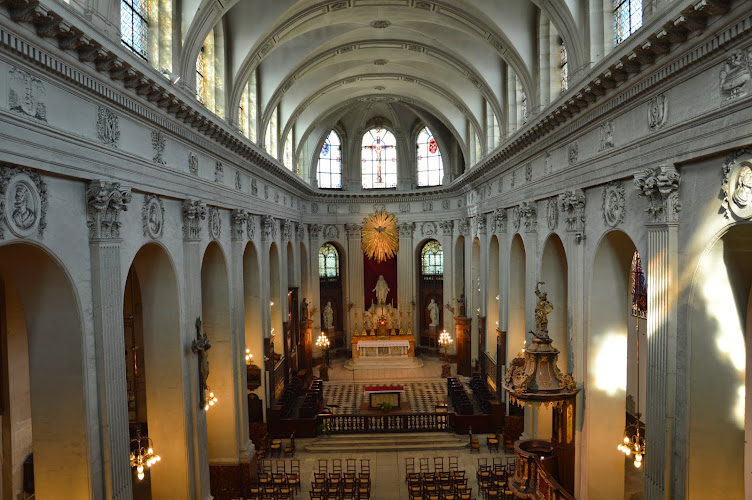
Duval\s baroque reconstruction created the elegant interior visitors admire today, with classical columns featuring Corinthian capitals, rounded arches, and the predominantly white color scheme that honors the original White Coats while creating a luminous worship environment typical of French baroque church design.
Architectural recycling and Baltard\s intervention
In one of Paris\s most fascinating examples of architectural recycling, Victor Baltard transported the facade of the demolished Church of Saint-Éloi from Île de la Cité stone by stone in 1863. Built in 1704 by Jean-Sylvain Cartault, this neoclassical facade features superimposed classical orders—Doric pilasters below and Ionic above—creating a dignified entrance that preserves architectural heritage while serving new religious purposes.
This architectural preservation demonstrates 19th-century commitment to saving important decorative elements even when buildings couldn\t be preserved in their original locations, creating unique architectural composites that honor multiple periods of French artistic achievement.
Revolutionary survival and baroque treasures
Despite revolutionary suppression and sale in 1796-97, the church was restored under Napoleon\s 1801 Concordat and purchased by the City of Paris in 1807. The transformation from monastery church to parish church ensured its survival while adapting its mission to serve the broader Marais community.
The interior preserves remarkable baroque features including a magnificent German rococo pulpit created in Bavaria in 1749, demonstrating international artistic exchange in religious decoration. The sculpted wooden pulpit was designed to ensure speakers would be visible and audible throughout the church, combining practical function with decorative artistry.
Essential information
- Original foundation: 1258 (Servite monastery)
- Current building: 1685-1690 (Charles Duval, baroque)
- Facade: 1704/1863 (transported from Saint-Éloi by Baltard)
- Location: 12 rue des Blancs-Manteaux, 4th arrondissement
- Name origin: Servite monks\ white woolen robes
- Architectural fusion: Medieval origins, baroque reconstruction, neoclassical facade
- Parish status: Since 1807 (formerly monastery church)
Architectural and artistic features
- Interior style: French baroque with predominantly white decoration
- Structural elements: Classical columns with Corinthian capitals, rounded arches
- Notable artwork: German rococo pulpit (Bavaria, 1749)
- Facade orders: Doric (lower) and Ionic (upper) classical elements
- Architectural recycling: Preserved Île de la Cité church facade
Monastic heritage transformed
Église Notre-Dame-des-Blancs-Manteaux embodies the remarkable adaptability of religious architecture and the continuing spiritual mission that transcends changing monastic orders and political upheavals. This extraordinary church demonstrates how sacred spaces can honor their medieval foundations while serving contemporary parish communities through architectural evolution that respects both historical heritage and current needs. For religious architecture enthusiasts, Marais explorers, or anyone interested in how sacred buildings adapt while preserving their essential spiritual character, Notre-Dame-des-Blancs-Manteaux offers a unique encounter with layered religious history, where the white-robed monks\ medieval foundation continues through baroque grandeur and neoclassical dignity to serve a living parish community in the heart of Paris\s most historically rich neighborhood.