
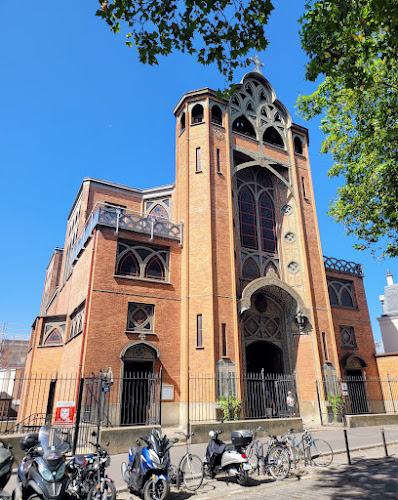
Hidden at the foot of Montmartre hill stands one of Paris’s most revolutionary churches—the Église Saint-Jean-de-Montmartre. This striking red-brick edifice at 19 Rue des Abbesses holds the distinction of being France’s first religious building constructed from reinforced concrete, a groundbreaking achievement that nearly led to its demolition before completion.
## A Revolutionary Vision Born from Necessity
In the 1890s, Father Sobbeaux faced a growing challenge. The population of lower Montmartre was expanding rapidly, but the neighborhood’s only church, Saint-Pierre de Montmartre atop the hill, was too small and too far for many residents. Father Sobbeaux envisioned a new church to serve his community and took on the personal mission of raising all construction funds.
The project attracted architect Anatole de Baudot (1834-1915), a visionary student of Viollet-le-Duc and Henri Labrouste. Baudot won the competition with an audacious proposal: build the entire church using reinforced concrete, a revolutionary material that would reduce costs while creating previously impossible architectural forms.
## Concrete Controversy and Legal Battles
Baudot’s use of reinforced concrete—employing engineer Paul Cottancin’s patented system from 1892—was so avant-garde that it terrified building inspectors. They objected to 25-meter-high columns only 50 centimeters in diameter and outer walls just seven centimeters thick. Even fellow architects predicted catastrophic collapse.
In 1898, a lawsuit halted construction for “non-conformity of town planning,” followed by a demolition order. To save their revolutionary church, Baudot and Father Sobbeaux constructed full-scale concrete column models in the church garden, demonstrating the material’s strength and stability. This dramatic proof convinced skeptics, the demolition order was lifted, and construction resumed.
## Art Nouveau Meets Byzantine Grandeur
Completed in 1904, Saint-Jean-de-Montmartre presents a fascinating architectural hybrid. The exterior blends Byzantine and Art Deco influences, while the distinctive red-brick facade—which earned it the nickname “Saint-Jean-of-the-Bricks”—provides both structural support and insulation.
The portal showcases elaborate ceramic designs and sculptures by Alexandre Bigot, while bronze angels by Pierre Roche frame the porch. These Art Nouveau decorative elements create an ethereal beauty that contrasts dramatically with the church’s industrial appearance from the rear.
## Stained Glass Masterpieces
Inside, the church reveals its true artistic treasures. The nave features spectacular stained glass windows by Jac Galland, based on drawings by Pascal Blanchard, depicting Christ performing miracles. These larger windows are complemented by 48 smaller triangular windows illustrating the Litanies of the Virgin.
The contrast between the gray reinforced concrete interior and the brilliant colored glass creates a unique atmosphere—dim arcades and tribunes suddenly illuminated by bursts of jewel-toned light from the immense windows above the choir.
## Engineering Marvel Hidden in Beauty
The church’s concrete structure demonstrates remarkable engineering innovation. The reinforced cement system allowed for soaring spaces impossible with traditional materials, while the geometric mosaics on the red-brick exterior showcase Art Nouveau’s organic forms and decorative philosophy.
Visitors often mistake the building for a factory when viewed from the back, a testament to its industrial honesty—yet the facade reveals unmistakable religious grandeur through its careful proportions and decorative artistry.
## Historical Recognition and Consecration
Originally consecrated on June 13, 1904, as a chapel to Saint John the Evangelist, the church became a parish church following the 1905 law separating church and state. Its revolutionary architecture was finally officially recognized when the entire building was classified as a historic monument on September 9, 2014.
## Visiting Saint-Jean-de-Montmartre
**Address:** 19 Rue des Abbesses, 75018 Paris
**Metro:** Abbesses (Line 12) – closest station
**Best Time to Visit:** Weekday mornings for optimal lighting of stained glass
**Duration:** 45-60 minutes for full appreciation
The church continues active parish life while welcoming visitors interested in architectural innovation and Art Nouveau artistry. Its location near the Abbesses Metro station makes it easily accessible, and its proximity to other Montmartre attractions creates perfect opportunities for extended exploration.
## Legacy of Innovation
Saint-Jean-de-Montmartre stands as proof that religious architecture could embrace modern materials and industrial techniques without sacrificing spiritual beauty. Baudot’s concrete pioneering influenced countless later architects, while the church’s Art Nouveau elements represent the movement’s successful integration into sacred architecture.
Today’s visitors witness not just a beautiful church, but a monument to architectural courage—a building that faced demolition for being too innovative and survived to inspire generations of architects worldwide.