
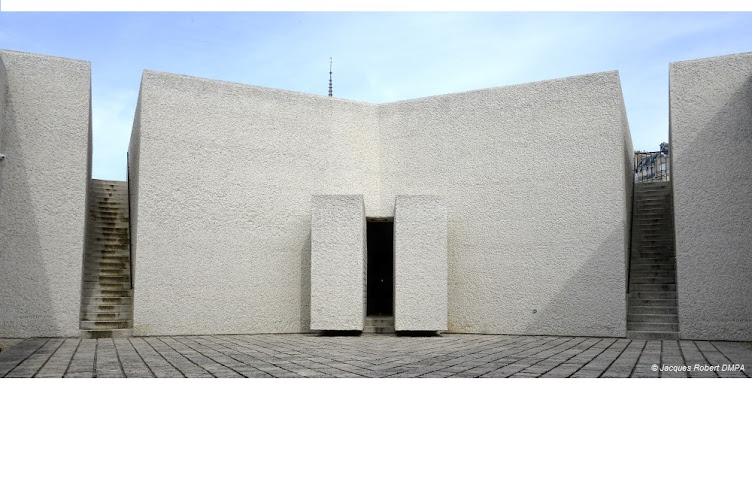
Modernist architecture for eternal remembrance
At the eastern tip of Île de la Cité, behind Notre-Dame Cathedral, the Mémorial des Martyrs de la Déportation stands as one of Paris\s most profound monuments to World War II suffering. Designed by modernist architect Georges-Henri Pingusson and inaugurated by Charles de Gaulle on April 12, 1962, this underground memorial creates an architectural experience that evokes the concentration camp world of imprisonment and oppression while honoring the 200,000 people deported from France to Nazi death camps.
Georges-Henri Pingusson\s architectural vision
Pingusson (1894-1978), one of the last great figures of French modernist architecture, spent nine years developing the memorial\s symbolic design, combining abstract forms with imposing artistic elements that suggest characteristic aspects of the concentration camp experience: imprisonment, oppression, and the impossibility of escape.
The architect\s approach created an “initiatory journey” that leads visitors through increasingly confined spaces, using architectural compression and darkness to evoke the psychological and physical conditions of deportation without exploiting or trivializing the historical experience.
Réseau du Souvenir and survivor advocacy
The memorial emerged from the “Réseau du Souvenir” association founded in 1952 by lawyer and resistance fighter Paul Arrighi, survivor of Mauthausen camp, and Annette Lazard, widow of a deportee who died at Auschwitz-Birkenau. Their personal experiences of loss and survival shaped the memorial\s mission to ensure that deportation memory would serve both commemoration and education.
This survivor-driven initiative ensured that the memorial would authentically represent the deportation experience while avoiding sensationalism or inappropriate artistic exploitation of suffering, creating sacred space for genuine remembrance and reflection.
Sacred crypt and symbolic presence
The memorial culminates in a crypt housing the remains of an unknown deportee alongside fifteen urns containing soil and ashes from principal Nazi camps, symbolically transferred on June 25, 1962. This sacred presence transforms the memorial from architectural monument into consecrated ground where the dead continue to bear witness to historical truth.
The crypt\s design creates intimate space for personal reflection while connecting visitors to the specific camps—Auschwitz, Bergen-Belsen, Mauthausen, and others—that marked the geography of systematic murder, ensuring that abstract historical knowledge becomes personal moral encounter.
Architectural pilgrimage and moral education
Pingusson\s design creates an architectural experience that functions as moral education, where spatial compression and symbolic elements help visitors understand deportation without exploiting suffering for dramatic effect. The memorial demonstrates how modernist architecture can serve commemorative functions that honor victims while educating contemporary audiences about historical responsibility.
The underground location behind Notre-Dame creates powerful juxtaposition between medieval Christian triumph and 20th-century Christian failure, where the cathedral that celebrates divine love stands above the memorial that mourns human hatred and systematic murder.
Universal lesson in sacred setting
While commemorating specifically French deportation experience, the memorial\s architectural language and moral message address universal themes of human dignity, state violence, and citizen responsibility. The memorial serves both French national memory and international understanding of genocide, demonstrating how local commemoration can carry universal moral significance.
Essential information
- Inauguration: April 12, 1962 (Charles de Gaulle)
- Architect: Georges-Henri Pingusson (modernist)
- Commemoration: 200,000 people deported from France to Nazi camps
- Location: Eastern tip of Île de la Cité, behind Notre-Dame
- Design period: Nine years of symbolic development
- Crypt elements: Unknown deportee remains, 15 urns with camp ashes
- Initiative: Réseau du Souvenir (survivor association)
Memorial experience
- Architectural journey: Progressive spatial compression evoking camp experience
- Symbolic elements: Narrow corridors, low ceilings, confined spaces
- Sacred presence: Crypt with deportee remains and camp ashes
- Educational mission: Moral education through architectural experience
- Universal message: Human dignity and citizen responsibility
Modernist memorial architecture
The Mémorial des Martyrs de la Déportation demonstrates how modernist architecture can serve sacred commemorative functions while maintaining aesthetic integrity and moral authority. This remarkable memorial proves that contemporary architectural language can honor historical tragedy without exploiting suffering for dramatic effect, creating spaces that educate through experience while respecting the dignity of victims and survivors. For memorial architecture enthusiasts, World War II historians, or anyone seeking to understand how societies commemorate systematic atrocity, this underground sanctuary offers an extraordinary encounter with architectural commemoration, where Pingusson\s modernist vision creates sacred space for reflection and moral education beneath the ancient stones of Île de la Cité, ensuring that the memory of 200,000 deportees continues to speak against indifference and injustice through architectural experience that transforms historical knowledge into personal moral encounter.