Sacred memory in the heart of the Marais
At 17 rue Geoffroy l\Asnier in the historic Marais, the Mémorial de la Shoah stands as one of Europe\s most important centers for Holocaust remembrance and education. Opened by President Jacques Chirac on January 27, 2005—chosen to coincide with International Holocaust Remembrance Day and the 60th anniversary of Auschwitz\s liberation—this profound memorial serves as both sacred space for remembrance and educational institution dedicated to ensuring that the lessons of the Shoah are never forgotten.
Wall of Names: 76,000 individual memories
The memorial\s most powerful feature is the Wall of Names, where the approximately 76,000 French Jewish men, women, and children deported and murdered by the Nazis are listed alphabetically by year of deportation. These walls create a passageway to the building that transforms approach into pilgrimage, where visitors must literally walk through the names of the dead to enter the memorial space.
Each name represents a individual life destroyed, a family shattered, a future extinguished. The Wall transforms abstract statistics into personal tragedy, ensuring that visitors understand the Holocaust not as historical abstraction but as the systematic murder of specific people with names, families, and dreams.
Crypt of sacred ashes and eternal memory
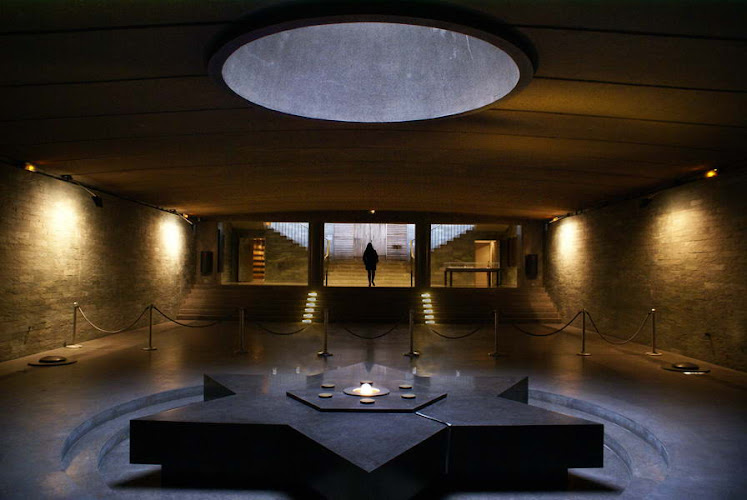
The memorial\s crypt, established in 1957, contains ashes of Holocaust victims from death camps and the Warsaw Ghetto, buried in soil from Israel to create sacred connection between French Jewish memory and the ancient homeland. A central cylindrical sculpture bears the names of concentration camps, death camps, and ghettos—Bergen-Belsen, Treblinka, Warsaw—that marked the geography of systematic murder.
This sacred space transforms the memorial from museum into mausoleum, where the ashes of the martyred create consecrated ground that demands reverence and ensures that their sacrifice sanctifies the space dedicated to preserving their memory.
Europe\s largest Shoah documentation center
Beyond its memorial function, the institution serves as Europe\s largest documentation center devoted to Holocaust history and the fate of Jews during World War II. The comprehensive archives, photographs, documents, and personal belongings create educational resources that support both academic research and public understanding.
The museum\s exhibitions trace the systematic development of Nazi persecution and the destruction of European Jewish communities, providing context that helps visitors understand how ordinary people became perpetrators, victims, or bystanders during humanity\s darkest chapter.
Teaching remembrance and fighting denial
The memorial\s central educational mission ensures that Holocaust memory serves contemporary needs for historical understanding and moral education. Through permanent exhibitions, temporary displays, and educational programs, the institution works to combat Holocaust denial while fostering critical thinking about genocide, racism, and human rights.
Free guided tours every Sunday and complimentary admission ensure that Holocaust education remains accessible to all visitors, reflecting the democratic principle that historical memory should serve the entire community rather than privileged elites.
Marais Jewish heritage and community continuity
The memorial\s location in the historic Jewish quarter of the Marais creates profound resonance between past and present, where centuries of Jewish life provide context for understanding the magnitude of Holocaust destruction. The surrounding neighborhood\s synagogues, kosher restaurants, and Jewish cultural institutions demonstrate the resilience of communities that survived and rebuilt after catastrophic loss.
Essential information
- Opening: January 27, 2005 (President Jacques Chirac)
- Location: 17 rue Geoffroy l\Asnier, 4th arrondissement
- Commemoration: 76,000 French Jews deported 1942-1944
- Crypt: Established 1957 with ashes from camps and Warsaw Ghetto
- Documentation: Europe\s largest Shoah research center
- Hours: Daily except Saturday, 10am-6pm (Thursday until 10pm)
- Admission: Free, guided tours Sunday 3pm
Memorial experience
- Wall of Names: 76,000 victims listed alphabetically by deportation year
- Educational mission: Teaching Holocaust history, combating denial
- Archives: Photographs, documents, personal belongings
- Sacred elements: Crypt with camp ashes, cylindrical sculpture with camp names
- Community context: Heart of historic Marais Jewish quarter
Sacred duty of remembrance
The Mémorial de la Shoah embodies the sacred responsibility of preserving Holocaust memory for future generations, where individual names and personal stories combat the abstraction that enables forgetting and denial. This profound memorial demonstrates how sacred architecture and educational mission can combine to create spaces that honor the dead while teaching the living about the dangers of hatred and the importance of human dignity. For anyone seeking to understand the Holocaust\s impact on French Jewish communities or the broader lessons about genocide and human rights, the memorial offers an essential encounter with history that transforms tragedy into education, ensuring that the sacrifice of 76,000 French Jews continues to speak against intolerance and indifference in the heart of the Marais, where Jewish life continues and memory endures.