
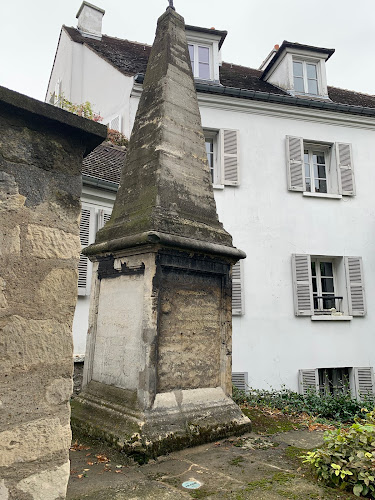
A Royal Scientific Monument
The Mire du Nord, also known as the Pyramide Cassini, stands as a remarkable testament to 18th-century French scientific achievement in the heart of Montmartre. This 3-meter-tall monument, classified as a Historical Monument since 1934, represents a crucial piece of astronomical history hidden within the private gardens of the Moulin de la Galette.
Jacques Cassini’s Ambitious Project
In 1736, renowned astronomer Jacques Cassini ordered the construction of this monument to serve as the northern reference point for measuring the Paris meridian. The Academy of Sciences had embarked on an ambitious project to measure the length of the meridian arc from the northern end to the southern end of France—a scientific endeavor that would contribute to our understanding of Earth’s dimensions.
The original inscription, placed by Cassini himself, reads: “In the year MDCCXXXVI this obelisk was erected by order of the King to serve as an alignment for the meridian of Paris on the north side. Its axis is 2,931 toises 2 feet from the meridional face of the Observatory.”
Architectural Design and Construction
The monument features a sophisticated geometric design: a parallelepiped (cuboid) base surmounted by a quadrangular pyramid. Master mason Rondel executed the construction on land owned by “named Ménessier, miller in Montmartre,” establishing this scientific marker in what was then rural countryside outside Paris.
The pyramid’s summit originally bore a fleur-de-lis, symbolizing royal authority over this scientific enterprise. This royal emblem reflected the French monarchy’s support for astronomical research and territorial measurement.
Revolutionary Changes and Adaptations
The monument’s appearance evolved with French political history. During the Revolution, the royal fleur-de-lis was replaced with a ball, reflecting the new republican values. Later, in 1840, an iron lance replaced the ball, giving the monument its current distinctive silhouette.
These changes demonstrate how even scientific monuments reflect broader social and political transformations, adapting their symbolism while maintaining their essential function.
Scientific Legacy and Meridian Measurements
The Mire du Nord formed part of an elaborate scientific network designed to establish precise geographical coordinates. This monument served as the northern anchor point for meridian calculations that extended from this Montmartre location all the way to the Paris Observatory and beyond to the southern boundaries of France.
The precision of these measurements contributed to the development of the metric system and enhanced understanding of Earth’s geometry, making this modest monument part of a scientific revolution that influenced global standards of measurement.
Modern Connections
In 1994, Dutch artist Jan Dibbets created the “Homage to Arago” installation, featuring 135 bronze medallions marking the Paris meridian throughout the city. According to researcher Philip Freriks, the Mire du Nord corresponds to medallion number 129, connecting this 18th-century scientific monument to contemporary public art commemorating French astronomical heritage.
This modern artistic intervention helps visitors understand the Mire du Nord’s role within the broader story of Parisian scientific achievement and urban geography.
Location and Accessibility
The Mire du Nord is located at 1 Avenue Junot in the 18th arrondissement, within the private gardens of the Moulin de la Galette complex. The monument sits in the block surrounded by rue Girardon, rue Lepic, and avenue Junot, placing it in one of Montmartre’s most historically rich neighborhoods.
While the monument stands on private property, its historical significance and protected status as a Monument Historique (PA00086754) ensure its preservation for future generations interested in French scientific heritage.
Astronomical and Cultural Context
The Mire du Nord represents the intersection of scientific precision and royal patronage that characterized 18th-century French astronomy. The monument embodies the Enlightenment belief that systematic observation and measurement could unlock nature’s secrets and improve human understanding of the world.
This scientific monument also reflects France’s ambition to lead European intellectual achievement, using royal resources to support astronomical research that would enhance French prestige and practical knowledge.
Hidden Heritage in Montmartre
Unlike Montmartre’s more famous artistic landmarks, the Mire du Nord represents the area’s lesser-known scientific heritage. Before becoming synonymous with bohemian artists and cabarets, Montmartre served practical roles in Parisian life, including hosting crucial scientific infrastructure like this meridian marker.
The monument’s survival amid Montmartre’s urban development demonstrates the importance of preserving diverse forms of cultural heritage, ensuring that scientific achievements receive recognition alongside artistic accomplishments.
Contemporary Significance
Today, the Mire du Nord serves as a reminder of humanity’s long quest to understand Earth’s dimensions and our place in the cosmos. While modern GPS technology has superseded the need for such ground-based reference points, this monument preserves the memory of an era when astronomical measurement required physical markers and meticulous ground-based calculations.
For visitors interested in the history of science, the Mire du Nord offers a tangible connection to the methodical work that laid the foundation for modern geography, cartography, and geodesy.
Exploring the Legacy
While the Mire du Nord itself may not be directly accessible due to its private location, visitors to Montmartre can appreciate its significance within the broader context of Parisian scientific heritage. The nearby streets of avenue Junot, rue Lepic, and rue Girardon offer opportunities to imagine the rural 18th-century landscape where Cassini’s astronomers conducted their precise measurements.
Consider combining interest in the Mire du Nord with visits to the Paris Observatory in the 14th arrondissement or seeking out the Arago medallions throughout Paris to understand the complete story of French meridian measurement and astronomical achievement.