
<\!-- wp:heading -->
Marie de Médicis\u2019 Florentine dream and the heart of French democracy
<\!-- /wp:heading --><\!-- wp:paragraph -->
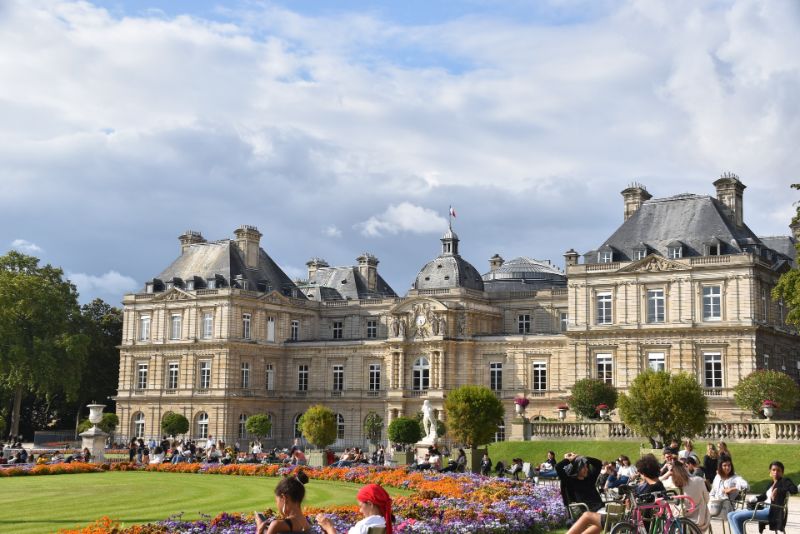
In the 6th arrondissement, the Palais du Luxembourg stands as both a magnificent example of 17th-century royal architecture and the contemporary seat of French democratic governance. Commissioned in 1615 by Marie de Médicis, widow of Henri IV and regent to Louis XIII, this palace represents her ambitious vision to recreate the Florentine spirit of her childhood within the heart of Paris, while today serving as the meeting place for the French Senate.
<\!-- /wp:paragraph --><\!-- wp:paragraph -->
After acquiring the Hôtel de Luxembourg and its extensive domain in 1612, Marie de Médicis commissioned what she called her “Palais Médicis,” specifically requesting that it be modeled after the Palazzo Pitti in Florence. This nostalgic project demonstrates how royal architecture could serve both practical residential needs and emotional connections to cultural heritage.
<\!-- /wp:paragraph --><\!-- wp:heading {"level":3} -->
Salomon de Brosse\u2019s architectural synthesis
<\!-- /wp:heading --><\!-- wp:paragraph -->
Architect Salomon de Brosse created a masterful synthesis of French and Italian architectural traditions, combining Renaissance elements with emerging French Baroque sensibilities. His design incorporates stone rustication characteristic of Florentine palaces while maintaining the classical balance and proportion that would define French architectural excellence throughout the 17th century.
<\!-- /wp:paragraph --><\!-- wp:paragraph -->
The palace\u2019s southern façade, featuring three avant-corps facing the garden, demonstrates sophisticated understanding of how buildings should relate to landscape design. The northern wings, comprising a front courtyard closed by a single-story gallery from Rue de Vaugirard, create ceremonial approach sequences that honor both royal dignity and urban integration.
<\!-- /wp:paragraph --><\!-- wp:heading {"level":3} -->
The Luxembourg Gardens: Florentine inspiration in Parisian landscape
<\!-- /wp:heading --><\!-- wp:paragraph -->
Marie de Médicis\u2019 garden, covering 23 hectares and inspired by Florence\u2019s Boboli Gardens, created one of Paris\u2019s most beloved public spaces beginning in 1612. The garden\u2019s central octagonal Grand Bassin, tree-lined promenades, and carefully orchestrated flowerbeds demonstrate how Italian Renaissance garden design could be adapted to French climate and cultural preferences.
<\!-- /wp:paragraph --><\!-- wp:parameter --><\!-- wp:paragraph -->
The Medici Fountain, built in 1630 by Florentine fountain maker Tommaso Francini, provides the garden\u2019s most direct connection to Marie de Médicis\u2019 Italian heritage. This hydraulic engineering masterpiece, brought from Florence by Henri IV, creates a romantic grotto that has enchanted Parisians for nearly four centuries while serving as a tangible link to Renaissance garden artistry.
<\!-- /wp:paragraph --><\!-- wp:heading {"level":3} -->
Revolutionary transformation to legislative palace
<\!-- /wp:heading --><\!-- wp:parameter --><\!-- wp:paragraph -->
The palace\u2019s transformation from royal residence to democratic institution occurred through Jean-François Chalgrin\u2019s modifications from 1799 to 1805. Chalgrin demolished the grand central staircase, replacing it with a senate chamber on the first floor that converted Marie de Médicis\u2019 intimate royal spaces into functional legislative facilities.
<\!-- /wp:paragraph --><\!-- wp:paragraph -->
This architectural adaptation demonstrates how royal buildings could be successfully repurposed to serve republican governance while maintaining their essential character and dignity. The transformation reflects broader French success in adapting monarchical infrastructure to democratic purposes following the Revolution.
<\!-- /wp:paragraph --><\!-- wp:heading {"level":3} -->
Contemporary Senate function and public access
<\!-- /wp:heading --><\!-- wp:parameter --><\!-- wp:paragraph -->
Today, the Luxembourg Palace serves as the seat of the French Senate, with the surrounding garden owned and maintained by the Senate for public enjoyment. This arrangement creates a unique synthesis of working democratic institution and accessible public space, demonstrating how contemporary governance can honor historical heritage while serving contemporary civic needs.
<\!-- /wp:paragraph --><\!-- wp:paragraph -->
The Senate\u2019s stewardship of both palace and garden ensures that Marie de Médicis\u2019 vision of creating beautiful public spaces continues to serve Parisians while providing an appropriate setting for the deliberations of France\u2019s upper legislative chamber. This dual function reflects French success in balancing institutional needs with public access to cultural heritage.
<\!-- /wp:paragraph --><\!-- wp:heading {"level":3} -->
Living heritage and democratic tradition
<\!-- /wp:heading --><\!-- wp:parameter --><\!-- wp:paragraph -->
The Palais du Luxembourg demonstrates how royal architectural vision can successfully transition to serve democratic purposes while maintaining aesthetic excellence and cultural significance. The building\u2019s continued use as a working legislative facility ensures that it remains a living part of French political life rather than merely a historical monument.
<\!-- /wp:paragraph --><\!-- wp:parameter --><\!-- wp:paragraph -->
For visitors to Paris interested in French history, garden design, or democratic institutions, the Luxembourg complex offers a comprehensive experience where Marie de Médicis\u2019 Florentine-inspired vision intersects with contemporary French governance. The combination of Salomon de Brosseu2019s architectural achievement, the gardenu2019s landscape artistry, and the Senateu2019s ongoing democratic function creates one of Parisu2019s most successful examples of how historical monuments can serve both cultural and practical purposes while remaining accessible to the public they ultimately serve.
<\!-- /wp:paragraph -->