
Paris’s last medieval cloister where miracles became art
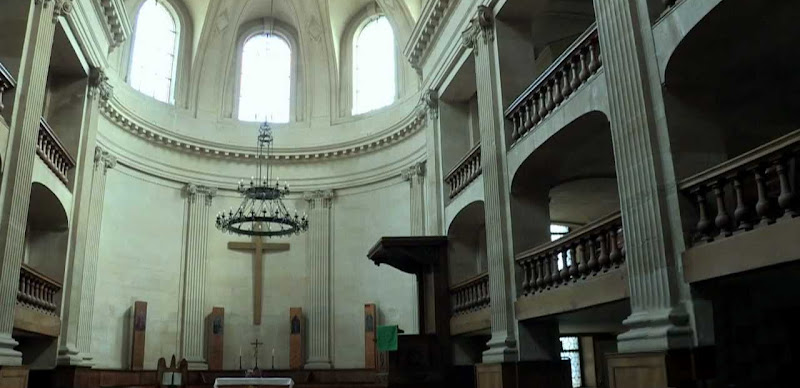
At 24 rue des Archives in the heart of the Marais, Temple des Billettes preserves one of Paris’s most extraordinary architectural treasures—the capital’s only surviving complete medieval cloister. Built in 1427 and attached to a neoclassical Protestant church, this remarkable Gothic ensemble demonstrates how medieval sacred architecture can adapt to serve different religious communities while maintaining its essential spiritual character, creating spaces where contemplative beauty serves both worship and contemporary artistic expression.
Medieval miracle and royal foundation
The site’s sacred history begins in 1299 when the Chapel of Miracles was built to commemorate a religious event that captured medieval imagination. King Philippe IV invited the Order of the Charity of Notre Dame, known as the Billettes, to arrange services in this new church, beginning a religious presence that would span over seven centuries despite changes in denomination and architectural style.
The chapel was rebuilt on a larger scale in 1405, with the addition of a cemetery and the magnificent cloister in 1427. This expansion demonstrates the site’s growing importance to Parisian religious life and the medieval belief that sacred architecture should create comprehensive environments for spiritual community and contemplation.
Gothic architectural perfection
The 15th-century cloister represents Gothic architecture at its most refined, featuring four galleries of arcades supported by elegant octagonal columns. The traverses are covered with Gothic rib vaults formed by pointed arches, while the keystones of the vaults are decorated with medieval sculpture that demonstrates the period’s integration of structural and artistic elements. This flamboyant Gothic cloister, restored to its original form in 1968, provides an authentic experience of medieval monastic architecture where contemplative spaces were designed to inspire spiritual reflection through architectural beauty. The vaulted galleries create intimate yet expansive spaces that demonstrate how Gothic architects balanced human scale with divine aspiration.Napoleon’s Protestant transformation
In 1808, Emperor Napoleon authorized the City of Paris to purchase the church and transfer it to the Lutheran Consistory, which was seeking a Parisian home for Protestant worship. This conversion reflected Napoleon’s broader policy of religious accommodation that aimed to integrate different Christian denominations into French civic life. The transformation from Catholic to Protestant use demonstrates how the same sacred architecture can serve different Christian traditions while maintaining its essential spiritual function, proving that great religious buildings transcend denominational boundaries through their capacity to inspire worship and contemplation.Contemporary artistic mission
Today, the medieval cloister serves dual purposes as both architectural heritage site and contemporary art gallery, where rotating exhibitions bring modern artistic expression into dialogue with Gothic architectural beauty. This innovative use demonstrates how historic religious spaces can serve cultural missions that honor their contemplative origins while engaging contemporary audiences. The free admission and diverse artistic programming ensure that the cloister remains accessible to all visitors, reflecting both Protestant principles of democratic access and contemporary beliefs that cultural heritage should serve the entire community rather than privileged elites.Architectural rarity and cultural continuity
As Paris’s only surviving complete medieval cloister, this architectural treasure provides irreplaceable insight into monastic life and Gothic architectural achievement. The building’s evolution from medieval Catholic foundation to Protestant church to contemporary cultural space demonstrates how great architecture can adapt while preserving its essential character and spiritual mission.Essential information
- Medieval foundation: 1299 (Chapel of Miracles)
- Cloister construction: 1427
- Church rebuilding: 1405
- Protestant conversion: 1808 (Napoleon I)
- Location: 24 rue des Archives, 4th arrondissement
- Architectural rarity: Paris’s only complete medieval cloister
- Restoration: 1968 (to original Gothic form)
Architectural and cultural features
- Gothic elements: Four arcade galleries, octagonal columns, rib vaults
- Decorative features: Sculpted keystones, pointed arches, flamboyant details
- Contemporary use: Art gallery with rotating exhibitions
- Church style: Neoclassical Protestant worship space
- Access: Free admission to cloister gallery