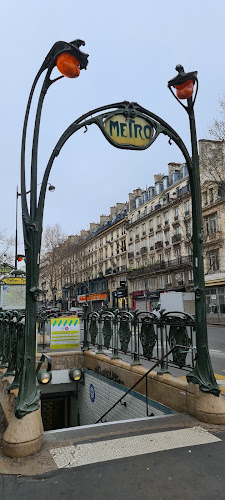
Édicule Guimard of the Château d’Eau station
Château d'Eau is a Paris Station De Transit landmark located in the 10 arrondissement. Guimard\u2019s Art Nouveau masterpiece at the historic water tower crossroads At the intersection of Boulevard de Strasbourg and rue du Château d\u2019Eau in the 10th arrondissement, the Édicule Guimard of Château d\u2019Eau station stands as one of Paris\u2019s most historically protected […]
Château d'Eau is a Paris Station De Transit landmark located in the 10 arrondissement.
<\!-- wp:heading -->
Guimard\u2019s Art Nouveau masterpiece at the historic water tower crossroads
<\!-- /wp:heading --><\!-- wp:parameter -->
At the intersection of Boulevard de Strasbourg and rue du Château d\u2019Eau in the 10th arrondissement, the Édicule Guimard of Château d\u2019Eau station stands as one of Paris\u2019s most historically protected Art Nouveau metro entrances and a testament to Hector Guimard\u2019s revolutionary vision of transforming utilitarian urban infrastructure into artistic expression. With two entrances classified as monument historique on May 29, 1978, this station represents the successful preservation of Guimard\u2019s organic design philosophy that challenged conventional Parisian architectural approaches through cast-iron forms that appeared to grow naturally from urban pavements.
<\!-- /wp:paragraph --><\!-- wp:parameter -->
The station\u2019s name derives from the historic Place du Château d\u2019Eau, which featured the Girard Fountain serving as a water tower until its replacement by the David Fountain in 1879. This connection to Parisian water infrastructure creates symbolic resonance between Guimard\u2019s organic design philosophy and the life-giving water systems that sustained urban growth and cultural development.
<\!-- /wp:paragraph --><\!-- wp:heading {"level":3} -->
Early historic monument recognition and preservation pioneering
<\!-- /wp:heading --><\!-- wp:parameter -->
The 1965 inscription of Château d\u2019Eau entrances among the first Guimard designs to receive historical monument protection—alongside Porte Dauphine, Ternes, Pigalle, and Hôtel de Ville—demonstrates early recognition of these entrances\u2019 exceptional cultural and artistic significance within French architectural heritage, establishing precedents for protecting functional urban infrastructure when it achieves artistic excellence.
<\!-- /wp:paragraph --><\!-- wp:parameter -->
This pioneering preservation effort reflects growing understanding that Art Nouveau metro entrances represented more than transportation infrastructure—they embodied comprehensive artistic vision that transformed daily urban experience while establishing French leadership in integrating artistic innovation with practical urban planning and public service delivery.
<\!-- /wp:paragraph --><\!-- wp:heading {"level":3} -->
Art Nouveau design principles and “le style Métro”
<\!-- /wp:heading --><\!-- wp:parameter -->
The station\u2019s entrances embody Guimard\u2019s revolutionary integration of iron, cast iron, glass, and enameled lava within sculptural balustrades and porticos topped by distinctive “Métropolitain” signage held aloft by tall candelabras. This comprehensive design approach created what became known as “le style Métro,” demonstrating how individual artistic vision could become synonymous with entire urban systems and cultural identity.
<\!-- /wp:paragraph --><\!-- wp:parameter -->
The organic, plant-like forms that characterize Guimard\u2019s entrance design reflect Art Nouveau philosophy about integrating natural inspiration with industrial materials, creating urban installations that appeared to emerge organically from city streets while serving practical transportation infrastructure needs with unprecedented aesthetic distinction and cultural sophistication.
<\!-- /wp:paragraph --><\!-- wp:heading {"level":3} -->
Water infrastructure heritage and urban development
<\!-- /wp:heading --><\!-- wp:parameter -->
The station\u2019s connection to historic water supply systems—from the original château d\u2019eau (water tower) through successive fountain installations—creates layered infrastructure history that demonstrates how urban development requires coordination of multiple municipal services including transportation, water supply, and aesthetic enhancement that serve both practical and cultural needs.
<\!-- /wp:paragraph --><\!-- wp:parameter -->
This infrastructure integration shows how great urban planning can coordinate diverse municipal functions while maintaining neighborhood character and cultural identity through comprehensive attention to both practical utility and aesthetic excellence that makes infrastructure enhancement rather than mere functional efficiency.
<\!-- /wp:paragraph --><\!-- wp:heading {"level":3} -->
Democratic design and artistic accessibility
<\!-- /wp:heading --><\!-- wp:parameter -->
The preservation of Château d\u2019Eau\u2019s Guimard entrances ensures that contemporary metro users can continue experiencing authentic Art Nouveau design as part of daily transportation, demonstrating Guimard\u2019s democratic vision of bringing artistic excellence to mass transit infrastructure that serves all social classes and economic backgrounds without discrimination or cultural exclusion.
<\!-- /wp:paragraph --><\!-- wp:parameter -->
For visitors to the 10th arrondissement interested in Art Nouveau design, urban infrastructure history, or the integration of artistic innovation with public transportation, Château d\u2019Eau station offers an exceptional encounter with how Hector Guimard\u2019s artistic vision continues serving contemporary transportation needs while preserving important connections to Belle Époque innovation and artistic excellence. The station demonstrates that great public art emerges when artistic vision meets infrastructure necessity, creating urban installations that serve both practical transportation functions and broader cultural purposes while establishing lasting monuments to the democratic ideal that artistic excellence should enhance rather than separate from daily urban experience.
<\!-- /wp:paragraph -->