

Disclosure: This article contains an affiliate link. If you book through it, Paris Top Ten may earn a commission at no extra cost to you.
Last verified: July 2026. Paris traffic, low-emission, parking, and licence rules can change. Check the linked official sources before driving.
Driving in Paris is possible, but it is rarely the easiest way to sightsee in central Paris. A car becomes more useful when you are moving between suburbs, carrying substantial luggage, or leaving the capital for a road trip. Before getting behind the wheel, confirm that your licence is valid in France, check the vehicle’s Crit’Air status, understand the Paris Centre limited-traffic zone, and decide where you will park.
If you have not driven recently, the safest approach is not to “learn by doing” in heavy Paris traffic. Book a dual-control refresher lesson, practise in stages, and make your first independent route short and predictable. The goal is calm, lawful driving—not proving that you can handle Place Charles-de-Gaulle on day one.
Key takeaways
- An EU or EEA licence is generally valid in France while it remains valid and its conditions are met. Rules for non-EU licences vary for visitors, students, and new residents.
- Most Paris streets have a 30 km/h limit. The Boulevard Périphérique has a 50 km/h limit, but posted signs always take priority.
- A Crit’Air sticker is required to drive in the Grand Paris low-emission zone. Vehicle restrictions and temporary exemptions depend on the vehicle category and current rules.
- Transit traffic is prohibited in the Paris Centre limited-traffic zone. You may enter when your trip begins or ends inside the zone or another exemption applies.
- Visitor street parking is time-limited. A pre-booked garage is often simpler than circling for a curb space.
- Fontainebleau and Giverny are sensible first road-trip targets. Normandy and the Loire Valley suit a weekend; Alsace and Provence deserve a multi-day plan.
In this guide
- Should you drive in Paris?
- Licence, insurance, and rental checks
- How to rebuild your driving confidence
- Paris driving rules that catch newcomers
- A sensible first practice drive
- How to prepare for a road trip from Paris
- Scenic drives from Paris by confidence level
- Final driving checklist
- Frequently asked questions
Should you drive in Paris?
For a typical sightseeing itinerary, no. The Métro, RER, buses, trams, walking routes, and taxis remove the need to find parking or interpret changing traffic restrictions. Central Paris also demands constant attention to scooters, bicycles, pedestrians, bus lanes, delivery vehicles, one-way streets, and roadworks.
Driving makes more sense when you need to reach a place poorly served by transit, move between outer suburbs, transport bulky equipment, accommodate a mobility need, or continue directly into the French countryside. A useful compromise is to collect a rental car near the edge of Paris—or at a station outside the centre—on the morning you leave, rather than keeping it during your city stay.
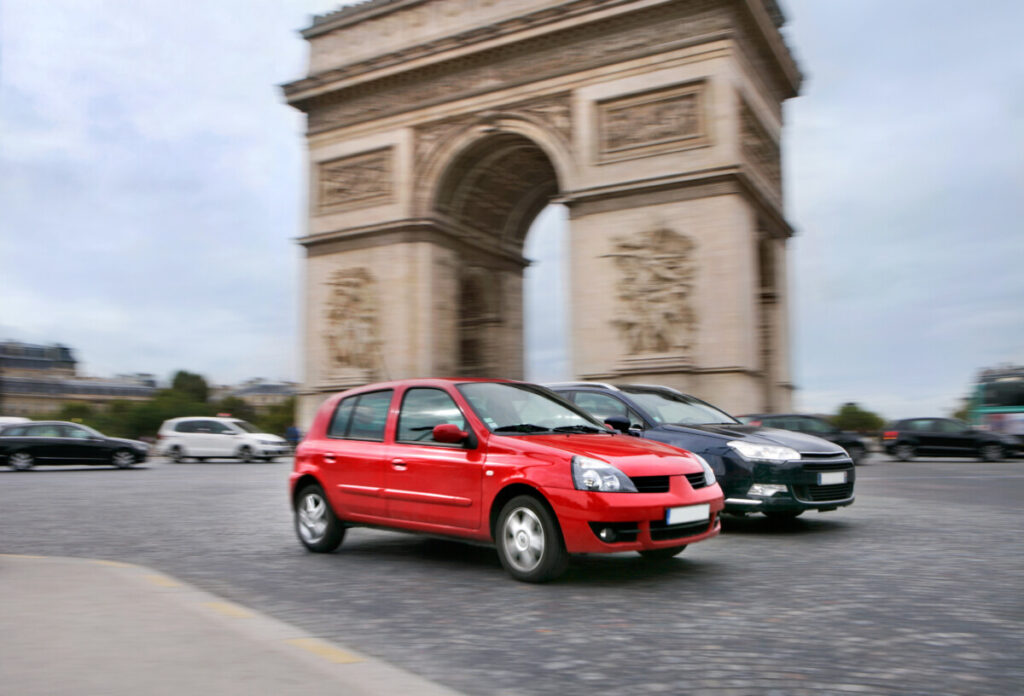
The junction around the Arc de Triomphe is a poor first practice route. It combines a wide circulating roadway, multiple entry points, rapid lane changes, and drivers positioning for different exits. You do not need to master it to drive safely elsewhere in Paris.
Check your licence, insurance, and rental terms
EU and EEA driving licences
A valid EU or EEA driving licence can generally be used in France while it remains in force and you meet its restrictions, such as wearing corrective lenses. France may require an exchange in specific circumstances, including expiry, loss, theft, damage, or certain serious traffic offences. The official Service-Public guidance for EU and EEA licences explains the exceptions.
Non-EU driving licences
Rules differ for visitors and residents. During a short stay, a valid non-EU licence may be accepted, but a licence that is not written in French must normally be accompanied by an international driving permit or an official translation. A person establishing normal residence in France can generally use an eligible non-EU licence for one year from the start of that residence, after which an exchange may be required and is not available for every issuing country. Check the separate official rules for a short stay with a foreign licence and for moving to France with a non-EU licence.
Do not rely on a rental company’s willingness to hand over the keys as proof that your documents satisfy French law. Confirm both the legal requirements and the rental company’s own age, licence-tenure, translation, and payment-card conditions before booking.
Insurance and the rental contract
Before departure, verify that every intended driver appears on the rental agreement or insurance policy. Review the damage excess, theft coverage, roadside-assistance number, territorial limits, fuel or charging policy, and rules for taking the vehicle across a border. Confirm that the car has the correct Crit’Air sticker and required safety equipment rather than assuming these details are automatic.
- Carry your physical driving licence and the rental agreement or vehicle registration documents.
- Keep the insurer or rental company’s emergency number available offline.
- Photograph the vehicle at collection and return, including wheels, glass, roof, fuel level, and dashboard warnings.
- Check the location of the high-visibility vest and warning triangle before setting off.
- Choose an automatic car if clutch control would add unnecessary cognitive load.
How to rebuild your driving confidence safely
Search for a cours de perfectionnement, remise à niveau, or stage de reprise de confiance rather than a beginner licensing package. France’s road-safety authority maintains the state-backed “École conduite qualité” label for driving schools, although you should still ask whether a school offers refresher sessions for already licensed drivers.
When contacting a school, specify the skills you want to practise. A useful request might include an automatic dual-control car, an instructor who can teach in English, urban junctions, lane selection, modern roundabouts, parking, and a short section of the Périphérique. Ask whether the first session begins with an assessment and whether the pickup point can be outside the most congested part of Paris.
Use a five-stage progression
- Relearn the vehicle: seat and mirror position, controls, automatic-hold or parking-brake functions, navigation, and blind spots.
- Start on quiet roads: practise smooth braking, lane position, turning, and reading signs in an outer district or nearby suburb.
- Add one challenge at a time: introduce a standard roundabout, a busier junction, parallel parking, or a multilane boulevard without combining everything in one session.
- Practise a controlled exit from Paris: follow a pre-planned route to a motorway or main road, then return before fatigue builds.
- Take a simple day trip: choose Fontainebleau or Giverny before attempting a long weekend drive or a dense coastal itinerary.
A calm passenger can help after you have completed a professional refresher session, but a friend cannot brake or correct the steering from the passenger seat. Make sure that person is legally added as a second driver if they may take over. Do not use a random supermarket or commercial car park for practice without the owner’s permission and confirmation that the vehicle is insured for that use.
Paris driving rules that catch newcomers
Issue | Current rule | Practical response |
|---|---|---|
Speed | Most Paris streets are limited to 30 km/h; the Périphérique is limited to 50 km/h. | Follow posted signs and use the speed limiter if the car has one. |
Périphérique reserved lane | When the white-diamond signal is illuminated, part of the left lane is reserved for vehicles with at least two occupants and other authorized users. | Move out of the lane safely if you are driving alone and the signal activates. |
Crit’Air and the ZFE | A Crit’Air sticker is required in the Grand Paris low-emission zone; vehicle-category restrictions apply at specified times. | Verify the car’s category and current exemptions before entering the zone. |
Paris Centre ZTL | Through-traffic is prohibited; trips beginning or ending inside the zone are allowed, subject to the rules. | Route around the centre unless you have a destination inside it. |
Parking | Visitor curb parking is paid and limited to six consecutive hours in the same space. | Reserve a garage and enter the registration number carefully. |
Priority | Signs and road markings determine priority; an unsigned junction may use priority to the right. | Slow early and check the right side instead of assuming the larger road has priority. |
Phones | Holding a mobile phone while driving is prohibited. | Set navigation before moving and stop legally before touching the phone. |
Most of Paris is limited to 30 km/h
Paris introduced a general 30 km/h limit across most of the city, with exceptions that include the Périphérique, the Boulevards des Maréchaux, and certain main roads. The Périphérique’s limit was reduced to 50 km/h in October 2024. Outside Paris, France’s default limits vary by road type and weather, but a posted lower limit always controls. Review the national official speed-limit guidance before a longer trip.
The lower urban limit does not make driving effortless. At 30 km/h, your attention should move toward crossings, cyclists, scooters, door zones, and lane markings—not toward matching the speed of an impatient driver behind you.
Watch for the white-diamond reserved-lane signal
Part of the Périphérique’s left lane operates as a reserved lane when the illuminated white-diamond sign is active. The standard activation periods are Monday through Friday from 7:00 to 10:30 a.m. and 4:00 to 8:00 p.m., although the lane can be switched off when conditions require it. During activation, it is open to vehicles carrying at least two people and specified authorized users, including public transport and taxis. A solo driver should leave the lane safely when the signal activates. Check the current Périphérique reserved-lane rules before using it.
Priority rules and roundabouts require active observation
At many modern roundabouts, a triangular cédez le passage sign tells entering traffic to yield to vehicles already circulating. At an unsigned intersection, however, the priorité à droite rule may give priority to a vehicle approaching from your right. Do not generalize one rule to every circular junction or assume that the wider road automatically has priority.
Signal early enough to communicate your exit, check mirrors and blind spots before changing position, and abandon a turn rather than cutting across a lane at the last second. Missing an exit costs a few minutes; forcing it can cause a collision.
Expect pedestrians and cyclists from both directions
Paris has extensive cycle infrastructure, including contraflow bicycle movements on some streets that are one-way for cars. Before turning or opening a door, check the mirror, blind spot, and cycle lane. Yield to pedestrians who are entering or clearly intending to enter a crossing, and do not stop across a bicycle box or crosswalk while waiting at a light.
Keep the phone out of your hand and alcohol out of the plan
Handheld phone use while driving is prohibited. Programme the route, audio, and destination parking before moving, then pull over legally if the route needs attention. France’s legal blood-alcohol ceiling is 0.5 g/L for most drivers and 0.2 g/L for probationary drivers and certain learners. The safer road-trip rule is simpler: if you are driving, do not drink. This matters especially on vineyard routes in the Loire Valley and Alsace.
Check Crit’Air and the Grand Paris low-emission zone
A Crit’Air emissions sticker is required to drive in Paris and the wider Grand Paris low-emission zone, whose main perimeter is inside the A86 ring road while the A86 itself is excluded. Since January 2025, the restriction stage includes Crit’Air 3, Crit’Air 4, Crit’Air 5, and unclassified vehicles within the applicable perimeter and times. For private cars, the normal restricted period is Monday through Friday from 8:00 a.m. to 8:00 p.m., excluding public holidays. As of July 2026, the Métropole du Grand Paris describes controls through December 31, 2026 as punctual and informational, but that does not remove the obligation to comply.
Use the City of Paris ZFE page to review the current perimeter, affected vehicles, exemptions, and 24-hour pass. Order a sticker only through the official Crit’Air website; third-party sites may add unnecessary fees.
Do not use Paris Centre as a shortcut
The Paris Centre limited-traffic zone, or ZTL, has operated since November 2024. Traffic whose origin or destination is inside the zone is permitted, while driving through the zone merely as a shortcut is prohibited. Navigation apps may not always explain why a route is undesirable, so check the official Paris Centre ZTL map and rules before entering.
Plan parking before you start the engine
Visitor curb parking in Paris is limited to six consecutive hours in the same space. It is paid Monday through Saturday from 9:00 a.m. to 8:00 p.m., except public holidays, and the registration number must be entered accurately. For a standard light visitor vehicle, rates last checked in July 2026 begin at €6 for one hour in Zone 1 (1st–11th arrondissements) and €4 in Zone 2 (12th–20th), rising to €75 and €50 respectively for six hours. Heavier vehicles can be charged substantially more. Verify the City of Paris parking rules and tariffs on the day you drive.
For a newcomer, a garage is often worth the added cost. Reserve a location with a straightforward entrance, confirm the vehicle-height limit, and save the booking offline. Photograph the bay number or level when you leave the car.
For more city-specific context, see our guide to navigating the streets of Paris.
A sensible first practice drive in Paris
Your first independent session should be a 60- to 90-minute skills check, not a sightseeing tour. Choose daylight, dry weather, and a period outside the main commuter and school-run peaks. Begin near the edge of the city or in a familiar suburb where you can join a main road without immediately crossing central Paris.
- Build the route before leaving. Use a simple loop with a known garage or legal stopping point and no more than one unfamiliar junction type.
- Preview the difficult moments. Note the correct lane for each turn, the motorway entry, and the exit before the destination.
- Silence unnecessary alerts. Use spoken directions, but turn off incoming-message previews and avoid changing the destination while moving.
- Stop before your concentration drops. End the session while it still feels controlled, then note what needs another instructor-led practice.
Avoid Place Charles-de-Gaulle, Place de la Concorde, the busiest Seine quays, and a central-ZTL crossing on this first route. Confidence grows faster through repeatable success than through one overwhelming drive.
Before leaving Paris for a road trip
Leaving the capital introduces a different set of decisions: motorway exits, tolls, fuel or charging stops, weather, holiday congestion, and destination parking. Complete the following checks the evening before departure.
- Review traffic forecasts: France’s official Bison Futé service publishes forecasts and real-time traffic information.
- Check toll payment: many autoroutes are tolled, and some sections use free-flow tolling without a traditional booth. Review the official free-flow toll guidance and confirm how and when payment is made for your route.
- Inspect required equipment: a high-visibility vest must be within reach and an approved warning triangle must be carried. Follow the official vehicle-equipment rules in an emergency.
- Download the route: mobile reception can be inconsistent on rural roads. Save the map, accommodation address, and parking instructions offline.
- Plan energy, not just distance: schedule breaks before fatigue, avoid a late-night return after a full sightseeing day, and share driving only with a named, insured driver.
- Consider train plus local rental: for Alsace and Provence, a high-speed train followed by a shorter local rental can reduce motorway time, tolls, fatigue, and the need to keep a car in Paris.
Scenic drives from Paris by confidence level
The best first route is not necessarily the most dramatic one. Choose a destination that fits your current confidence, daylight, and ability to manage the return drive. The times below are planning ranges from central Paris before major congestion, stops, weather, or roadworks.
Route | Typical drive | Best trip length | Recommended confidence |
|---|---|---|---|
Fontainebleau and Barbizon | About 1 to 1.5 hours | Full day | Beginner after a refresher lesson |
Giverny and the Seine Valley | About 1.25 to 2 hours | Full day | Beginner to intermediate |
Loire Valley | About 2 hours to Chambord | 1 to 3 nights | Intermediate |
Normandy coast | About 2.5 to 3.5 hours | 2 to 3 nights | Intermediate |
Alsace Wine Route | Roughly 5 to 6 hours to Colmar | 3 to 5 nights | Confident; train plus local car often easier |
Provence and Pont du Gard | Roughly 6.5 to 8 hours | 4 to 7 nights | Confident; train plus local car recommended |
For a broader route shortlist, compare these options with our guide to the best road trips in France.
1. Fontainebleau and Barbizon: the best first confidence-building drive
Fontainebleau is the strongest first choice because the destination is close enough to keep the day manageable, while the route gives you experience leaving Paris and joining the A6. The official château directions route drivers from Paris via the A6 and the Fontainebleau exit.
A practical day begins after the morning rush. Drive directly to a preselected car park in Fontainebleau, visit the château or town, then continue the short distance to Barbizon if your energy remains steady. Return before darkness rather than adding several forest stops. Weekends and good-weather days can be busy, so the route is easier when you avoid the main arrival and departure peaks.
Why it suits a newer driver: the outbound structure is clear, the total mileage is modest, and you can omit the second stop without losing the day.
2. Giverny and the Seine Valley: motorway practice with a rural finish
Giverny is roughly 75 kilometres west of Paris. The official Giverny access directions use the A13 toward Rouen, followed by local roads around Vernon and Giverny. It is a useful next step after Fontainebleau because the drive introduces a different motorway exit and a quieter final section.
Make Giverny the only fixed attraction on your first attempt. Monet’s house and gardens are seasonal and popular, so reserve a timed ticket and confirm opening dates. If the return drive still feels comfortable, add a short Seine Valley stop; otherwise, head back before the Paris evening peak.
Why it suits a newer driver: it combines a straightforward destination with optional—not mandatory—extra stops. See more ideas in our guide to day trips from Paris.
3. Loire Valley: châteaux without an overpacked schedule
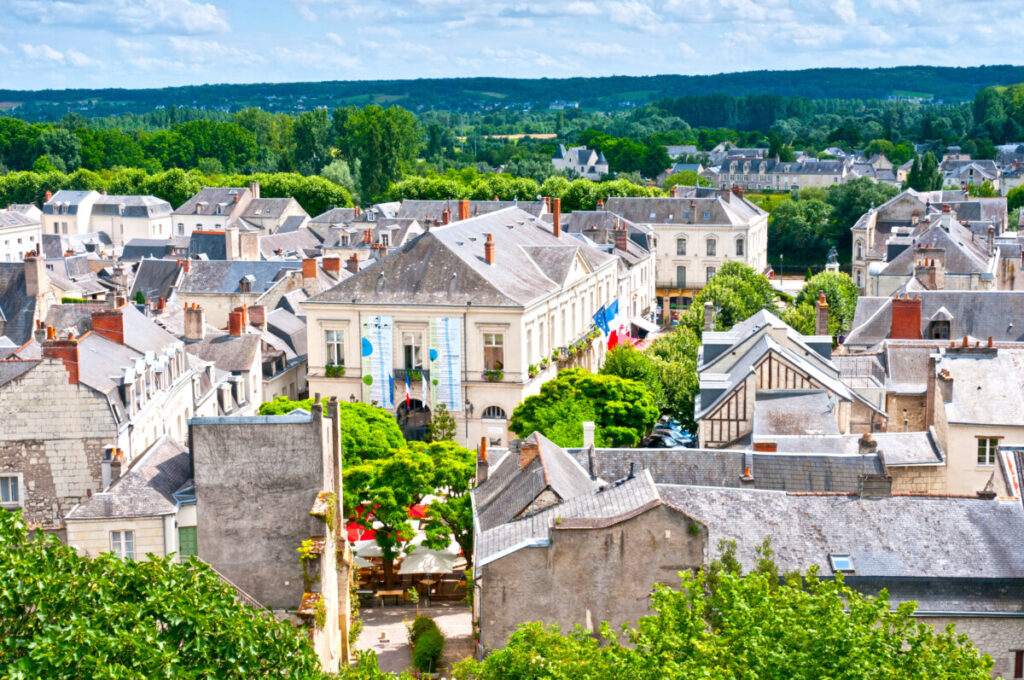
Château de Chambord is less than two hours south of Paris in normal conditions, making the eastern Loire Valley reachable in a day. The mistake is trying to combine Chambord, Chenonceau, Amboise, Tours, and Chinon in one rushed circuit. The distances between sites, parking, meals, and château visits add up.
For two nights, use a simple westbound progression: Chambord or Blois on the first day, Amboise or Chenonceau on the second, and Chinon only if it fits your accommodation plan. For one night, stay in the eastern or central Loire rather than treating Chinon as a quick detour.
Driving caution: rural roads can be narrow, and cyclists are common. Build in passing space and time. If wine tasting is part of the trip, appoint a sober driver or stay overnight within walking distance of the tasting.
4. Normandy coast: Houlgate, Honfleur, and Étretat

Normandy works better as a weekend than as a long day trip. Houlgate or another Côte Fleurie town can serve as a base, with Honfleur or the Alabaster Coast added on a separate day. This keeps you from driving back to Paris after hours of coastal sightseeing.
Étretat deserves special planning. Normandy Tourism recommends arriving early or late, visiting outside peak periods, and avoiding the busiest summer weekends when possible. Parking and pedestrian pressure make the centre less relaxing than the approach suggests. Choose one coastal objective rather than racing between every famous viewpoint.
Travellers who prefer not to drive the final coastal segment can compare a private guided Étretat excursion from Caen. Check the departure point, cancellation terms, and inclusions before booking.
5. Alsace Wine Route: a destination drive, not a quick escape
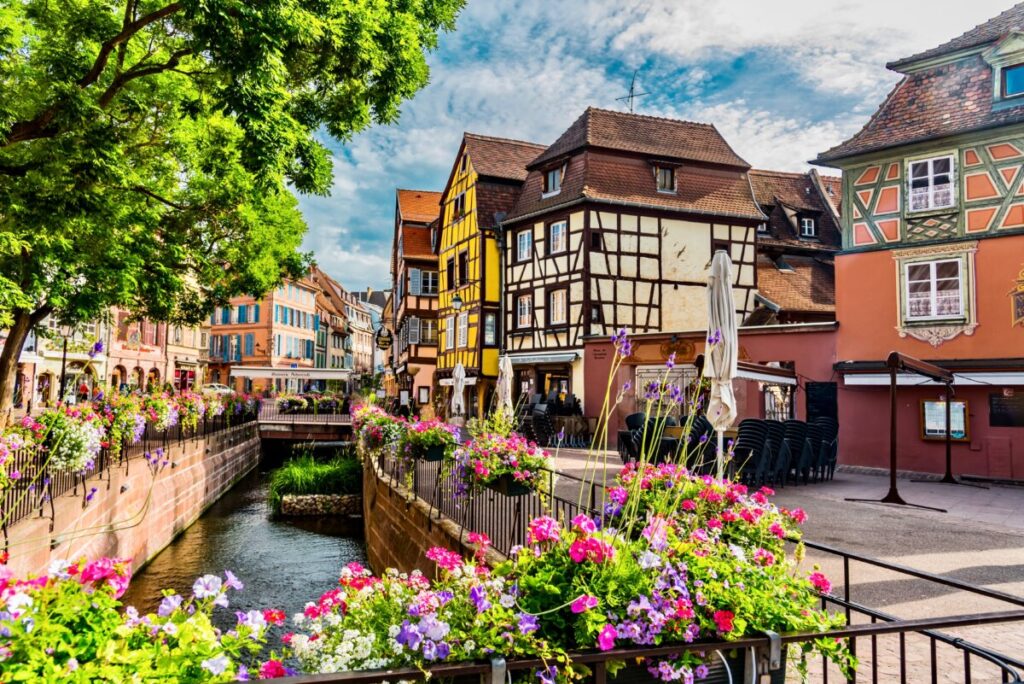
The official Alsace Wine Route runs for about 170 kilometres through vineyard landscapes and towns between the northern and southern ends of the region. Colmar is a practical base for short loops to places such as Eguisheim, Kaysersberg, Riquewihr, and Ribeauvillé.
Driving from Paris can make sense as part of a longer east-France itinerary, but it is an inefficient first road trip. For many travellers, the calmer option is a high-speed train to Strasbourg or Colmar followed by a local rental. This removes a long motorway day while preserving the flexibility that makes the wine route useful.
Driving caution: do not structure the day around multiple tastings and then drive. Use a designated driver, spit during tastings, book a driver or tour, or stay in the village where you plan to taste.
6. Provence and Pont du Gard: take the train, then rent locally
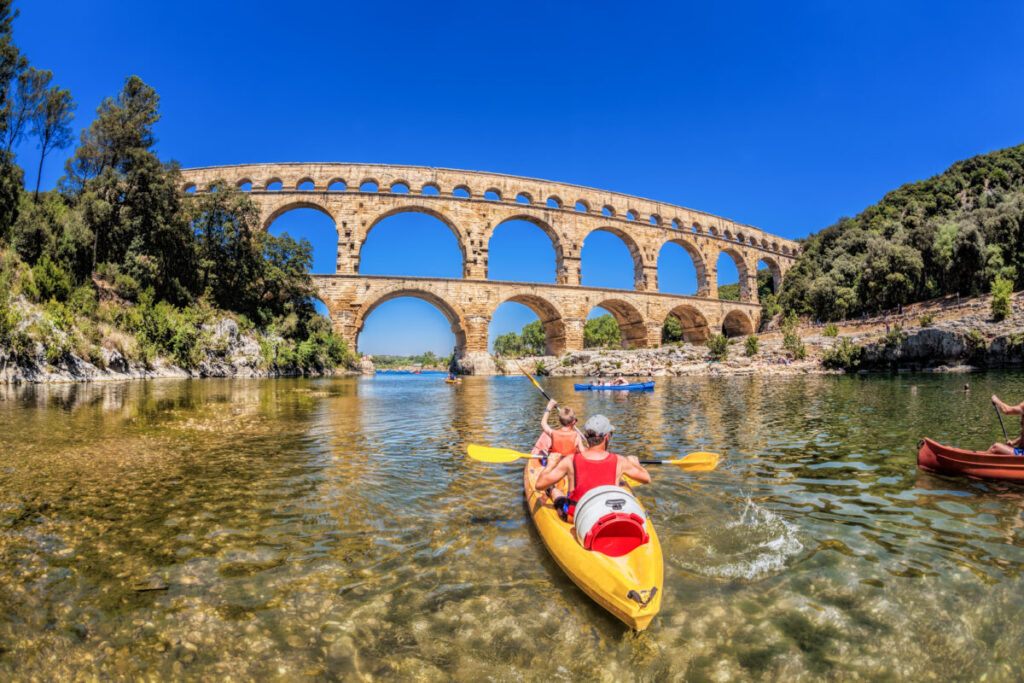
Provence is too far from Paris to treat as a confidence-building drive. A direct road journey consumes most of a day before traffic, meals, and rest stops. The more efficient plan is often a TGV to Avignon or Nîmes, then a local rental for a loop linking Avignon, Uzès, Pont du Gard, Arles, or selected Luberon villages.
Pont du Gard sits about 27 kilometres from Nîmes and 21 kilometres from Avignon, with road access near the A9. The site’s own travel information notes that the Paris–Nîmes TGV takes about 2 hours 50 minutes, which illustrates why rail plus a local car can be more practical than driving the entire distance.
If lavender is a priority, verify current flowering reports instead of building the trip around a fixed “lavender season.” Bloom timing shifts with elevation, variety, and weather. Keep the driving day short enough to handle narrow village streets, limited parking, heat, and strong winds without rushing.
Final checklist before driving in Paris
- Valid licence, required translation or international permit, and identification
- Rental agreement or registration documents and confirmed insurance
- Every driver named on the contract or policy
- Correct Crit’Air sticker and current ZFE eligibility
- Route checked against the Paris Centre ZTL and temporary closures
- Garage or destination parking selected before departure
- High-visibility vest within reach and warning triangle in the vehicle
- Seat, mirrors, lights, controls, and navigation set while stationary
- Live traffic and weather reviewed through an official source
- No alcohol for the driver and a break plan for longer journeys
Driving in Paris does not need to be a test of nerve. Use an instructor to close specific skill gaps, choose a simple first route, and treat the car as a tool for the journeys where it genuinely improves the trip. Once the basics feel automatic, France’s road network opens up a much broader range of day trips and regional itineraries.
Frequently asked questions
Is driving in Paris difficult?
Driving in Paris can be demanding because of dense traffic, bicycles, scooters, pedestrians, complex junctions, restricted zones, and limited parking. A refresher lesson and a short outer-Paris route are safer starting points than central sightseeing by car.
Can I drive in Paris with an EU licence?
A valid EU or EEA licence can generally be used in France while it remains valid and you comply with its conditions. Exchanges are required only in specified situations, such as expiry, loss, theft, damage, or certain offences.
Do I need a Crit’Air sticker to drive in Paris?
Yes. A Crit’Air sticker is required in the Grand Paris low-emission zone. Your vehicle’s category determines when it may circulate, so check the official ZFE rules and any current exemptions before driving.
What is the speed limit in Paris?
Most Paris streets are limited to 30 km/h. The Boulevard Périphérique is limited to 50 km/h, while some other roads have posted exceptions. Road signs and temporary restrictions always take priority.
Where should I practise driving near Paris?
Start with a dual-control refresher lesson in an outer district or nearby suburb. After that, use a simple daylight loop before progressing to a manageable day trip such as Fontainebleau or Giverny.
Is a car useful for visiting Paris?
Usually not for central sightseeing. Public transport, walking, and taxis avoid parking and traffic restrictions. A car is more useful for suburbs, luggage-heavy journeys, mobility needs, and road trips beyond Paris.
What is the easiest scenic drive from Paris?
Fontainebleau and Barbizon are the best first option for many drivers. The route is relatively short, the A6 approach is clear, and the second stop can be skipped if the driver becomes tired or traffic worsens.
Find Things to Do in Paris
Find Accommodation

Continue Planning Your Paris Trip

Do US Citizens Need a Visa to Visit Paris? Essential Rules to Know
Planning a trip to the City of Light? Good news—visiting Paris is pretty easy for Americans. US citizens…
Read Guide →Paris Fashion Week Travel Guide: Ultimate Insider Tips and Hotspots
You don't need a runway seat to experience Paris Fashion Week. Catch street style, designer boutiques, pop-up installations,…
Read Guide →
Travel Agencies in Paris: 10 Current Agencies and Tour Operators for 2026
Planning a Paris trip and want local expertise? Ten travel agencies for 2026, from boutique luxury specialists to…
Read Guide →