
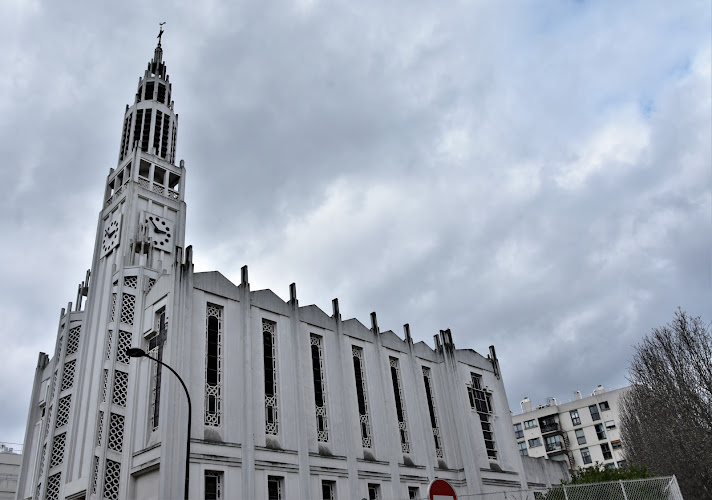
Art Deco masterpiece for the working class
Rising majestically at 79 rue Alexandre-Dumas in the 20th arrondissement, Église Saint-Jean-Bosco stands as one of Paris’s most remarkable examples of Art Deco religious architecture. Built between 1933 and 1938 under the visionary “Chantiers du Cardinal” program, this church represents a revolutionary approach to sacred architecture that brought modernist beauty to working-class neighborhoods while honoring the educational mission of its patron saint.
Cardinal Verdier’s vision for modern sacred architecture
The church emerged from Cardinal Verdier’s ambitious program to serve Paris’s rapidly growing working-class communities. As Archbishop of Paris from 1929, Verdier recognized that some peripheral parishes contained over 100,000 residents without adequate spiritual facilities. His “Chantiers du Cardinal” program aimed to build 60 churches throughout Paris and its suburbs, bringing architectural dignity to disadvantaged neighborhoods.
Saint-Jean-Bosco was the sixtieth church completed under this program, with its foundation stone blessed by Cardinal Verdier on December 10, 1933, and the completed church consecrated on October 10, 1937. The project demonstrated the Catholic Church’s commitment to modern architectural expression in service of social mission.
Romanian architectural innovation in Paris
Designed by Romanian architect Dumitru Rotter and his son René, the church draws inspiration from Auguste Perret’s pioneering reinforced concrete church at Notre-Dame du Raincy. The Rotters adapted Perret’s innovations to create a uniquely harmonious Art Deco composition that demonstrates how international architectural exchange enriched Parisian religious architecture.
The church’s most striking feature is its 53-meter bell tower, inspired by the tower at Notre-Dame du Raincy but executed with distinctive Art Deco styling. The tower houses a carillon of 28 bells crafted by the renowned Atelier Pacard, creating both visual landmark and musical celebration for the neighborhood.
Unified Art Deco artistic program
What makes Saint-Jean-Bosco extraordinary is the complete artistic unity achieved through its decoration program. All elements—paintings, murals, stained glass, mosaics, statues, and architectural details—were created within a single decade, resulting in one of the most harmonious Art Deco sacred spaces in Europe.
The decorative program was executed by the Brothers Mauméjean of Paris, with stained glass by André de Brissac of Grenoble depicting scenes from the lives of French saints including Joan of Arc, Bernadette, and Saint Jean Bosco himself. The ironwork, designed by Raymond Subes (famous for French ocean liner interiors), demonstrates how Art Deco style could enhance sacred spaces.
Innovative concrete construction
The church showcases pioneering use of reinforced concrete, with massive concrete pillars dividing the nave into six bays and supporting a balcony that provides additional seating. This structural innovation allowed for the large, unobstructed interior spaces necessary for substantial congregations while creating dramatic vertical emphasis typical of Art Deco design.
The concrete construction enabled the church’s distinctive aesthetic, where structural elements become decorative features and the building’s modernity serves its sacred function. Stained glass windows at balcony level flood the interior with colored light, creating an atmosphere that is both contemporary and timeless.
Honoring Saint John Bosco’s educational mission
The church’s dedication to Saint John Bosco (1815-1880) reflects its mission to serve working-class communities. The Italian Catholic priest founded the Salesian order and devoted his life to educating disadvantaged children, making him an appropriate patron for a church built to serve Paris’s working families.
The architectural program honors this educational mission through its accessibility, beauty, and functionality, demonstrating that modern architecture could create inspiring sacred spaces for all social classes, not just the wealthy neighborhoods that typically received architectural attention.
Essential information
- Construction: 1933-1938
- Architects: Dumitru Rotter and René Rotter
- Architectural style: Art Deco
- Location: 79 rue Alexandre-Dumas, 20th arrondissement
- Bell tower height: 53 meters with 28-bell carillon
- Heritage status: French national historic monument (2001)
- Program: 60th church of Cardinal Verdier’s “Chantiers du Cardinal”
Artistic features
- Decorative program: Brothers Mauméjean (unified Art Deco design)
- Stained glass: André de Brissac workshop, Grenoble
- Ironwork: Raymond Subes (ocean liner designer)
- Structural innovation: Reinforced concrete with massive pillars
- Artistic unity: All elements created within one decade
Art Deco sacred architecture
Église Saint-Jean-Bosco stands as one of the most successful examples of Art Deco sacred architecture in Paris, demonstrating how modern design principles could enhance rather than compromise religious experience. This remarkable church proves that innovative architecture can serve both aesthetic and social missions, creating beautiful sacred spaces for working-class communities while advancing the boundaries of religious design. For architecture enthusiasts, Art Deco admirers, or anyone interested in how sacred architecture evolved in the 20th century, Saint-Jean-Bosco offers an extraordinary encounter with unified artistic vision, where every element contributes to a harmonious celebration of faith, beauty, and social justice beneath soaring concrete arches that reach toward both heaven and the future.