
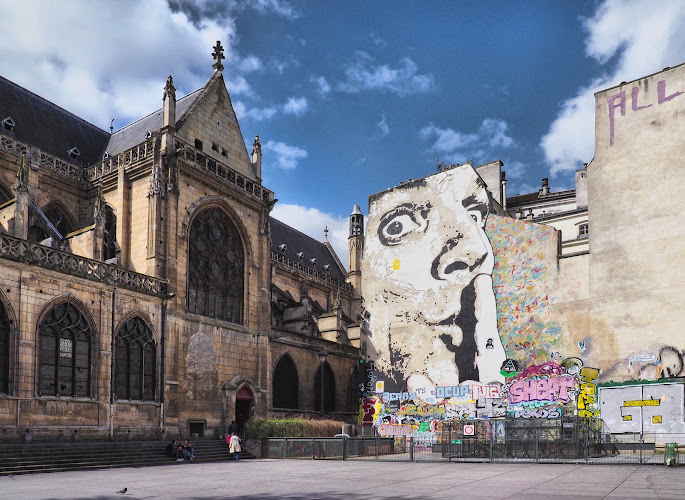
Flamboyant Gothic survivor in modern Paris
Standing at the junction of rue Saint-Martin and rue de la Verrerie in the 4th arrondissement, Église Saint-Merri presents one of Paris\s most fascinating architectural contrasts, where flamboyant Gothic grandeur meets contemporary artistic innovation. Built between 1500 and 1565 at the height of the Renaissance, this remarkable church deliberately maintained Gothic traditions while the rest of Europe embraced classical revival, creating a unique architectural statement that celebrates medieval French artistic achievement.
Gothic loyalty in the Renaissance era
Begun under King François I around 1520 and completed by 1560, Saint-Merri represents a fascinating architectural choice to maintain flamboyant Gothic style during the full flowering of Renaissance classicism. While contemporary buildings embraced Italian-inspired classical orders, this church celebrated the culmination of medieval French Gothic tradition with no trace of Renaissance influence.
Saint Médéric\s enduring legacy
The church takes its name from Saint Médéric (later contracted to Saint Merri), an abbot who died in 700 AD and was canonized for his devotion to the Christian community. The saint\s remains still rest in the church\s crypt, maintaining an unbroken connection to the early Christian history of Paris that spans over 1,300 years.
This continuity of sacred presence creates profound historical depth, where medieval sanctity continues to anchor a neighborhood that has evolved from religious quarter to artistic district centered around the nearby Centre Pompidou.
Flamboyant architectural mastery
Saint-Merri showcases flamboyant Gothic at its most sophisticated, with abundant floral and vegetal carved decoration, sculptures of fantastic creatures on door and window casings, and the intricate stonework that characterized the final phase of Gothic architectural development. The church contains one of Paris\s oldest church bells, dating from 1331, connecting contemporary worship to medieval spiritual traditions.
The interior masterfully blends Gothic architecture with Renaissance decorative elements, creating stained glass windows from the early 16th century that depict the lives of saints including St. Nicholas, St. Agnes, and St. Francis of Assisi. The ornate pulpit, supported by sculptured palm trees and created by Pierre-Alexis Hemon between 1753 and 1761, demonstrates how different artistic periods enhanced the church\s spiritual mission.
Artistic treasures and cultural synthesis
Medieval sacred meets contemporary art
Essential information
- Construction: 1500-1565
- Royal patron: King François I
- Architectural style: Flamboyant Gothic (late medieval)
- Location: 76 rue de la Verrerie, 4th arrondissement
- Patron saint: Saint Médéric (died 700 AD, remains in crypt)
- Notable feature: Church bell from 1331 (among Paris\s oldest)
- Nickname: “Notre Dame le petit” (little Notre Dame)
Artistic treasures
- Stained glass: Early 16th-century windows depicting saint lives
- Paintings: Charles Le Brun\s “The Baptism of Jesus”
- Decorative elements: Ornate pulpit with palm tree sculptures (1753-1761)
- Architectural details: Floral and vegetal carved decoration, fantastic creatures
- Modern context: Adjacent to Centre Pompidou and Stravinsky Fountain