
<\!-- wp:heading -->
A circular architectural marvel and historic transport gateway
<\!-- /wp:heading --><\!-- wp:paragraph -->
At Place Denfert-Rochereau in the 14th arrondissement, this remarkable circular railway station represents a unique chapter in Parisian transport history. Built between 1842-1846 by architect Alexis Dulong, Gare de Denfert-Rochereau holds the distinction of being the oldest railway building still standing in Paris and one of the first stations in the French railway network.
<\!-- /wp:paragraph --><\!-- wp:paragraph -->
Originally opened as Gare d\u2019Enfer on June 7, 1846, the station was later renamed to honor Pierre Philippe Denfert-Rochereau, the heroic defender of Belfort during the Franco-Prussian War. This transformation from “Gate of Hell” to a patriotic memorial reflects the evolving identity of this significant Parisian landmark.
<\!-- /wp:paragraph --><\!-- wp:heading {"level":3} -->
Revolutionary circular design
<\!-- /wp:heading --><\!-- wp:paragraph -->
The station\u2019s most striking feature is its circular architecture, designed to accommodate a rail loop that allowed trains to make U-turns—a system known as a “racket.” This innovative solution was part of Claude Arnoux\u2019s original rail network design, which used broad gauge tracks of 1,750mm to navigate tight urban curves.
<\!-- /wp:paragraph --><\!-- wp:paragraph -->
The neoclassical building features a rectangular central structure topped with a pediment containing two allegorical figures representing railway invention and a central clock. The curved lateral buildings maintain the same neoclassical style, creating a harmonious ensemble that exemplifies mid-19th-century French architectural elegance.
<\!-- /wp:paragraph --><\!-- wp:heading {"level":3} -->
Engineering evolution and adaptation
<\!-- /wp:heading --><\!-- wp:paragraph -->
The station originally served the Ligne de Sceaux using the innovative Arnoux system, which required specially designed engines capable of traveling on broad gauge tracks through very tight curves. This ambitious engineering experiment was eventually abandoned in 1891 when the line was converted to standard gauge, demonstrating the station\u2019s adaptability to changing technologies.
<\!-- /wp:paragraph --><\!-- wp:paragraph -->
In 1895, the line extended to Luxembourg station, creating the new Port-Royal station along the route. This expansion integrated the historic terminus into Paris\u2019s growing rail network, setting the stage for its eventual transformation into a modern transport hub.
<\!-- /wp:paragraph --><\!-- wp:heading {"level":3} -->
Modern multimodal connection
<\!-- /wp:heading --><\!-- wp:paragraph -->
The station underwent its most significant transformation in 1977 when it became part of RER Line B, connecting central Paris to Charles de Gaulle Airport and northern suburbs. This integration linked the historic terminus to Châtelet-Les Halles, creating one of Paris\u2019s most important north-south transport corridors.
<\!-- /wp:paragraph --><\!-- wp:paragraph -->
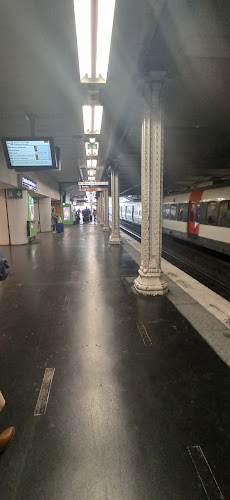
Today, Denfert-Rochereau serves as a crucial multimodal hub where RER B intersects with Métro lines 4 and 6. This convergence makes it an essential transfer point for travelers heading to major destinations including the airport, Latin Quarter, and Montparnasse district, while preserving its historic character.
<\!-- /wp:paragraph --><\!-- wp:heading {"level":3} -->
Gateway to underground Paris
<\!-- /wp:heading --><\!-- wp:paragraph -->
Beyond its transport function, Denfert-Rochereau station serves as the entrance to the famous Paris Catacombs, adding another layer to its significance as a portal between different worlds. This proximity to one of Paris\u2019s most intriguing underground attractions makes the station a natural starting point for exploring both the city\u2019s transport heritage and its subterranean mysteries.
<\!-- /wp:paragraph --><\!-- wp:paragraph -->
The juxtaposition of 19th-century railway architecture with modern RER infrastructure creates a compelling narrative about Paris\u2019s continuous adaptation and modernization while respecting its historical foundations.
<\!-- /wp:paragraph --><\!-- wp:heading {"level":3} -->
Architectural significance
<\!-- /wp:heading --><\!-- wp:paragraph -->
As the oldest surviving railway building in Paris, Gare de Denfert-Rochereau represents a crucial moment in urban development when railways began reshaping European cities. Its circular design, unique among Parisian stations, demonstrates the experimental spirit of early railway engineering and the willingness to innovate in service of urban mobility.
<\!-- /wp:paragraph --><\!-- wp:paragraph -->
For architecture enthusiasts and transport historians, the station offers a rare glimpse into the pioneering era of French railways, when engineers and architects collaborated to create functional buildings that also served as symbols of technological progress and national pride.
<\!-- /wp:paragraph -->