
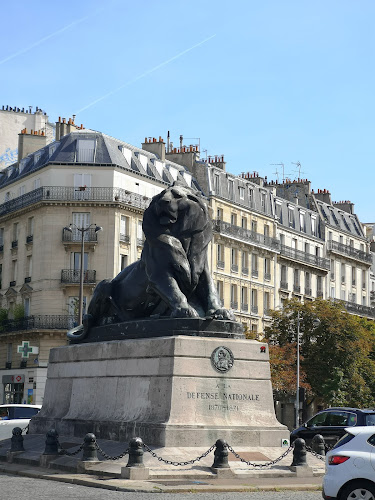
Bartholdi’s bronze guardian of French resistance
At Place Denfert-Rochereau in the 14th arrondissement, the Lion de Belfort stands as one of Frédéric Auguste Bartholdi’s most powerful monuments to French military courage and national resistance. Inaugurated in 1880, this magnificent bronze sculpture—measuring 7 meters long and 4 meters high—represents a one-third scale replica of Bartholdi’s original masterpiece in Belfort, demonstrating how great public art can commemorate heroic sacrifice while inspiring contemporary viewers with timeless symbols of courage and determination.
Colonel Denfert-Rochereau and the siege of Belfort
The monument honors Colonel Pierre Denfert-Rochereau, who organized the heroic 103-day defense of Belfort from December 1870 to February 1871 during the Franco-Prussian War. This extraordinary resistance against overwhelming Prussian forces became a symbol of French military honor and civilian courage during one of the nation’s darkest military periods.
The square’s naming creates a clever municipal pun, as “Denfert” is pronounced exactly like “d’Enfer” (of Hell), referencing the square’s traditional name “Place d’Enfer” while honoring the colonel who defended France with hellish determination against foreign invasion.
Bartholdi’s artistic mastery and symbolic power
Created by Frédéric Auguste Bartholdi—sculptor of the Statue of Liberty—the Lion de Belfort demonstrates the artist’s genius for creating monuments that embody abstract ideals through powerful animal symbolism. The lion’s fierce expression and muscular build convey strength, determination, and uncompromising resistance that transform bronze into living symbol of national character.
Bartholdi positioned the Parisian lion to face toward the Île aux Cygnes and the direction of New York, creating symbolic dialogue between his two greatest monuments—the lion representing defensive courage and the Liberty statue embodying democratic ideals that emerged from French revolutionary tradition.
Community advocacy and neighborhood pride
Originally planned for the Buttes-Chaumont area, the monument’s final placement at Place Denfert-Rochereau resulted from a petition by 14th arrondissement residents who recognized the cultural value of hosting this significant artwork. This community advocacy demonstrates how local pride and cultural appreciation can influence municipal decisions about public art placement.
The residents’ successful campaign ensured that their neighborhood would become the permanent home for one of Bartholdi’s masterpieces, creating a cultural landmark that enhances local identity while serving broader educational and commemorative purposes.Historic monument status and ongoing preservation
The lion’s designation as a historic monument on June 17, 2003, acknowledges both its artistic merit and its significance in French commemorative culture. Recent restoration in 2001 and planned 2025 restoration work demonstrate continuing commitment to preserving this important example of 19th-century public sculpture and patriotic commemoration. These preservation efforts ensure that Bartholdi’s artistic vision and the memory of French resistance continue to inspire contemporary viewers while maintaining the monument’s physical integrity for future generations who will learn from this powerful symbol of courage under fire.Symbol of enduring French spirit
Today’s Lion de Belfort continues to serve its original commemorative purpose while functioning as beloved neighborhood landmark that connects 14th arrondissement residents to broader French historical memory. The monument proves that great public art can simultaneously serve local community pride and national cultural identity through symbols that transcend their specific historical origins.Essential information
- Sculptor: Frédéric Auguste Bartholdi
- Inauguration: 1880
- Dimensions: 7 meters long, 4 meters high
- Original: One-third scale of Belfort original
- Location: Place Denfert-Rochereau, 14th arrondissement
- Commemoration: 103-day siege of Belfort (1870-1871)
- Heritage status: Historic monument (June 17, 2003)
- Recent restoration: 2001, planned 2025
Artistic and cultural significance
- Symbolic direction: Faces toward Statue of Liberty/New York
- War commemoration: Franco-Prussian War resistance
- Artistic connection: Bartholdi’s mastery before Statue of Liberty
- Community advocacy: 14th arrondissement residents secured placement
- National symbolism: French courage and determination