
## Description
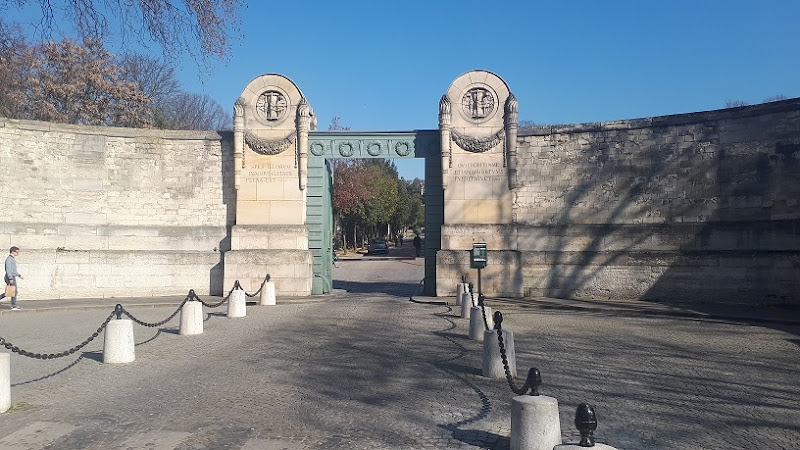
Standing majestically at the intersection of Boulevard de Ménilmontant and Rue de la Roquette in the 20th arrondissement, the main gate of Père-Lachaise Cemetery represents one of Paris’s most significant architectural and cultural landmarks. Far from the confusing description of the cemetery as “the largest in the world since 1792,” this monumental entrance was actually designed by renowned architect Étienne-Hippolyte Godde in 1883 as a fitting portal to what would become the world’s most visited cemetery.
Étienne-Hippolyte Godde, serving as chief architect of Paris, created this neoclassical masterpiece to provide a dignified and imposing entrance worthy of the cemetery’s growing reputation. The gate features a horseshoe-shaped curved wall arrangement with tall central gates topped by two carved medallions or wreaths – powerful symbols representing wisdom and victory over death, incorporating classic funerary iconography that prepares visitors for their contemplative journey within.
The cemetery itself opened in 1804, taking its name from Père François de la Chaise (1624-1709), confessor to Louis XIV, who lived in the Jesuit house that was rebuilt in 1682 on this site. As the first garden cemetery and first municipal cemetery in Paris, Père-Lachaise revolutionized burial practices by moving beyond the overcrowded urban graveyards to create a peaceful, park-like setting outside the then-city limits.
When Père-Lachaise opened, its eastern location was considered inconveniently suburban, much like many modern cemeteries beyond city centers today. However, the foresight of city planners and the exceptional design by architect Alexandre-Théodore Brongniart created what would become the most famous cemetery in the world, now attracting approximately 3.5 million visitors annually.
The main entrance serves as the primary access point for both pedestrians and vehicles, positioned strategically to accommodate the massive visitor flow while maintaining the solemnity appropriate to this sacred space. The curved wall design creates a sense of enclosure and transition, psychologically preparing visitors to enter what locals call “la cité des morts” (the city of the dead).
Père-Lachaise spans an impressive area as the largest cemetery in Paris, with five entrances total, but the main gate designed by Godde remains the most architecturally significant and commonly used. The entrance is conveniently served by Metro Philippe Auguste (line 2) and buses 61 and 69, making it accessible to the millions who come to visit graves of famous figures including Oscar Wilde, Jim Morrison, Édith Piaf, and many others.
### Key Features
– **Architect**: Designed by Étienne-Hippolyte Godde, chief architect of Paris (1883)
– **Neoclassical Design**: Monumental curved wall with tall central gates
– **Symbolic Elements**: Carved medallions representing wisdom and victory over death
– **Strategic Location**: Boulevard de Ménilmontant opposite Rue de la Roquette
– **Historical Significance**: Main entrance to the world’s most visited cemetery
### Accessibility and Amenities
The main gate provides excellent accessibility and visitor services:
– **Public Transportation**: Metro Philippe Auguste (line 2), buses 61 and 69
– **Vehicle Access**: Accommodates both pedestrian and vehicular entry
– **Visitor Information**: Maps available at entrance to navigate the 44-hectare cemetery
– **Daily Access**: Open daily 8:00 AM to 5:30 PM (6:00 PM in summer)
– **Universal Access**: Main entrance designed for wheelchair accessibility
### Planning Your Visit
**Best Times to Visit**: Early morning (8:00-9:00 AM) offers the most peaceful experience with fewer crowds and beautiful light filtering through the trees. Late afternoon provides atmospheric golden hour photography opportunities.
**Average Visit Duration**: The cemetery itself requires 2-4 hours for a comprehensive visit, but appreciating Godde’s gate architecture takes just 10-15 minutes.
**Recommended Itinerary**: Begin by examining the architectural details of Godde’s gate design, grab a cemetery map at the entrance, then explore the main paths to visit famous graves while appreciating the garden cemetery concept that revolutionized urban burial practices.
**Historical Context**: The main gate should be understood as part of the broader 19th-century transformation of Paris under architects like Godde, who created dignified civic architecture that balanced grandeur with functionality.
**Cultural Significance**: This entrance represents the democratization of cemetery design – creating beautiful, park-like spaces for all social classes rather than limiting elaborate burial grounds to the aristocracy. The gate embodies the Republican ideals of the era while honoring the sacred function of this “city of the dead” that has become an integral part of Parisian cultural heritage.