
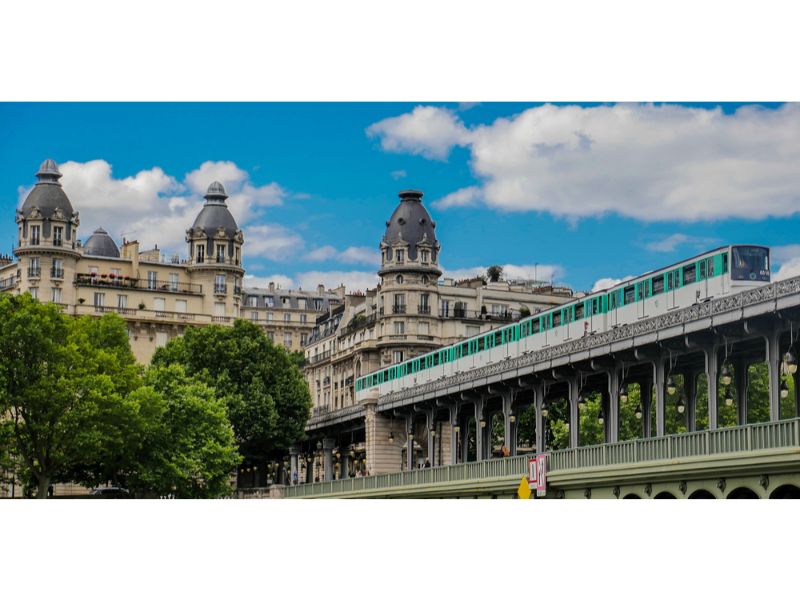
Pont de Bir-Hakeim
Pont de Bir Hakeim is a Paris Pont landmark located in the 15 arrondissement. Cinematic icon with Eiffel Tower views and wartime honor Spanning the Seine between the 15th and 16th arrondissements, Pont de Bir-Hakeim stands as one of Paris’s most photogenic and cinematically celebrated bridges, where Belle Époque engineering meets wartime commemoration beneath the […]
Pont de Bir Hakeim is a Paris Pont landmark located in the 15 arrondissement.
Cinematic icon with Eiffel Tower views and wartime honor
Spanning the Seine between the 15th and 16th arrondissements, Pont de Bir-Hakeim stands as one of Paris’s most photogenic and cinematically celebrated bridges, where Belle Époque engineering meets wartime commemoration beneath the shadow of the Eiffel Tower. Built in 1905 by engineer Louis Biette and architect Jean-Camille Formigé, this steel arch marvel gained international fame through countless films while honoring Free French heroism, creating a unique fusion of architectural beauty, transportation innovation, and cultural memory.
Innovative two-level design and Metro integration
The bridge’s revolutionary two-level structure demonstrates early 20th-century engineering innovation, with the lower deck accommodating road traffic and pedestrians while the upper deck serves as a viaduct for Metro Line 6. This dual-purpose design maximized urban transportation efficiency while creating one of Paris’s most spectacular public transit experiences.
The 237-meter-long, 25-meter-wide structure features metal colonnades with Art Deco street lights supporting the railway viaduct, while four monumental stone statues by sculptors Jules-Félix Coutan and Jean Antoine Injalbert represent Science, Labour, Electricity, and Commerce—embodying the Third Republic’s faith in progress and industrial achievement.
From Exposition bridge to wartime memorial
Originally built to replace a pedestrian footbridge constructed for the 1878 Exposition Universelle, the bridge was initially named Pont de Passy. The 1948 renaming to honor the Battle of Bir Hakeim transformed the structure into a memorial commemorating the 1942 battle where Free French forces fought heroically against the German Afrika Korps in Libya.
This wartime honor connects the bridge to Charles de Gaulle’s resistance legacy and the broader narrative of French liberation, demonstrating how infrastructure can serve both practical and commemorative purposes while maintaining its essential beauty and functionality.
Eiffel Tower spectacle and photographic fame
The bridge offers arguably the most spectacular views of the Eiffel Tower available from any Parisian bridge, particularly at sunrise and sunset when light plays across both the tower structure and the flowing Seine. This photographic perfection has created “virtually an industry of Bir-Hakeim photography,” where the bridge’s arches frame the iconic tower in countless tourist photographs and professional shoots.
The Bir-Hakeim metro station, positioned on the bridge’s left bank approach, provides the closest Metro access to the Eiffel Tower while offering travelers spectacular elevated views during their journey across the Seine, making public transportation itself a scenic experience.
Hollywood’s favorite Parisian bridge
The bridge’s unique design and atmospheric setting have made it a favorite location for international filmmakers, appearing in major productions including “Inception,” “Last Tango in Paris,” “Rififi,” “National Treasure: Book of Secrets,” and “Ronin.” This cinematic fame has elevated the bridge from local landmark to global symbol of Parisian romance and urban sophistication.
The bridge’s appearance in “Inception” particularly showcased its dramatic architectural lines and relationship with the Eiffel Tower, introducing the structure to new international audiences while reinforcing Paris’s status as the world’s most cinematic city.Art Deco elegance and heritage protection
The bridge’s 1986 designation as a historic monument recognizes both its architectural significance and its role in Parisian urban development. The Art Deco decorative elements and elegant proportions demonstrate how early 20th-century engineers could create infrastructure that served practical needs while achieving artistic distinction. The successful integration of transportation infrastructure with architectural beauty and scenic experience establishes Pont de Bir-Hakeim as a model for how great urban design can enhance rather than compromise city aesthetics while serving multiple transportation modes efficiently.Essential information
- Construction: 1905
- Engineer: Louis Biette
- Architect: Jean-Camille Formigé
- Original name: Pont de Passy
- Renamed: 1948 (Battle of Bir Hakeim commemoration)
- Dimensions: 237m length, 25m width
- Heritage status: Historic monument (1986)
- Transportation: Metro Line 6 viaduct, road traffic, pedestrians
Cultural and cinematic significance
- Film appearances: Inception, Last Tango in Paris, Rififi, National Treasure
- Photography: Premier location for Eiffel Tower views and professional shoots
- Sculptures: Science, Labour, Electricity, Commerce (Coutan and Injalbert)
- Art Deco features: Decorative street lights, metal colonnades
- Transportation hub: Closest Metro access to Eiffel Tower
Where engineering meets cinema
Pont de Bir-Hakeim embodies the intersection of functional infrastructure and cultural icon, where Belle Époque engineering created a structure so beautiful it became one of the world’s most filmed bridges while serving essential transportation needs for over a century. This remarkable bridge demonstrates how great urban design can achieve multiple forms of success—practical service, aesthetic achievement, commemorative purpose, and cultural symbolism. For film enthusiasts, bridge lovers, or anyone seeking the perfect Eiffel Tower photography location, Bir-Hakeim offers an extraordinary encounter with Parisian engineering poetry, where every crossing provides spectacular views while honoring French military courage beneath Art Deco elegance that has welcomed millions of travelers into one of the world’s most beautiful urban experiences.