
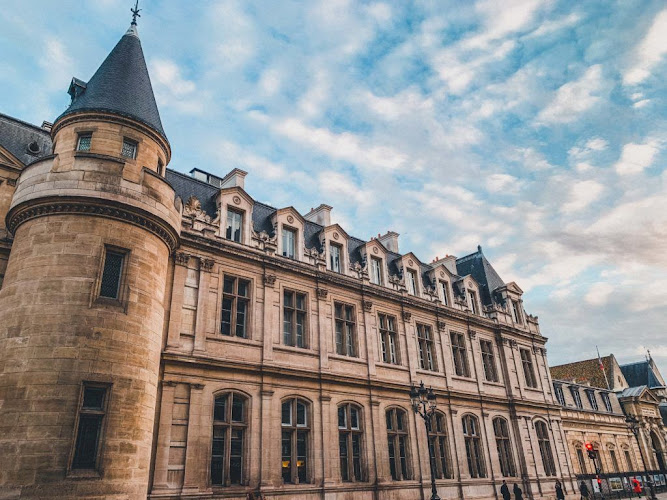
From Cluny\s powerhouse to scientific temple
At 270 rue Saint-Martin in the 3rd arrondissement stands one of Paris\s most remarkable architectural survivors—the Prieuré Saint-Martin-des-Champs, where medieval monastic grandeur meets modern scientific discovery. This extraordinary complex, founded in 1060 and rebuilt as a Gothic masterpiece in the 12th century, has evolved from one of Europe\s most powerful monasteries to home of the prestigious Musée des Arts et Métiers, creating a unique fusion of sacred architecture and technological innovation.
Merovingian origins and royal foundation
The site\s sacred history extends back to the 6th and 7th centuries, when a Merovingian funerary basilica was constructed on this location, later renovated during the Carolingian period. The current priory was founded in 1060 when Henry I decreed the abbey be rebuilt according to the order of Saint Augustine, establishing it as a royal foundation with significant political and religious influence.
In 1079, King Philippe I transferred ownership to the powerful Abbey of Cluny under the direction of Saint Hugh, making Saint-Martin-des-Champs one of the principal priories of the Cluniac order, known as the “Second Daughter of Cluny.” This connection to Cluny brought enormous prestige and resources that enabled the construction of the magnificent Gothic buildings we see today.
Gothic architectural masterpiece
The priory church, constructed during the 12th century alongside Notre-Dame Cathedral, represents one of the finest examples of early French Gothic architecture in Paris. The surviving buildings showcase the architectural innovations that defined the Gothic style—soaring arches, intricate stone carvings, and revolutionary structural techniques that allowed unprecedented height and lightness.
The church\s nave, with its tall columns and elaborate stonework, demonstrates the technical mastery and artistic vision of medieval builders who created spaces designed to inspire both monks and pilgrims. The Gothic architecture reflected the spiritual aspirations and worldly power of the Cluniac order at its height.
Revolutionary transformation and scientific mission
The French Revolution decimated the monastic community, and the former priory buildings were quickly occupied by shops, private residences, and municipal offices. However, through the influence of Abbé Grégoire, founder of the Conservatoire des Arts et Métiers, the institution found its new home at rue Saint-Martin in 1798.
The transformation from religious to scientific institution created one of the world\s most extraordinary adaptive reuse projects, where Gothic architecture designed for contemplating the divine now houses collections dedicated to human technological achievement. The museum officially opened to the public in 1802, beginning its mission to democratize scientific knowledge.
Temple of technology and scientific heritage
Today\s Musée des Arts et Métiers occupies the vast spaces of the former priory, spanning several blocks to house one of the world\s most comprehensive collections of technological innovation. The museum\s treasures include the original Foucault pendulum (with a replica in the Panthéon), exhibits on communication and energy, and scientific instruments that tell the story of human ingenuity.
The medieval church now serves as a spectacular exhibition space where Gothic architecture creates an almost cathedral-like atmosphere for contemplating technological achievement. This unique setting transforms scientific education into an almost spiritual experience, where visitors can appreciate both the beauty of medieval craftsmanship and the elegance of scientific innovation.
Cultural continuity and educational mission
The priory\s transformation from monastic center of learning to public museum of technology demonstrates remarkable continuity in educational mission. Both the medieval monks and modern curators share the goal of preserving and transmitting knowledge, though the subjects have evolved from theology to technology.
This evolution reflects broader changes in how society approaches learning and discovery, where the systematic approach to knowledge that characterized medieval monasticism continues to inform modern scientific education and public enlightenment.
Essential information
- Original foundation: 1060 (royal foundation under Henry I)
- Gothic construction: 12th century
- Cluniac period: 1079-1789 (Second Daughter of Cluny)
- Museum establishment: 1802 (Musée des Arts et Métiers)
- Location: 270 rue Saint-Martin, 3rd arrondissement
- Architectural style: Early French Gothic
- Current function: Museum of technology and scientific innovation
Museum experience
- Collections: Original Foucault pendulum, scientific instruments, technological innovations
- Architecture: Gothic church nave as exhibition space
- Educational mission: Democratizing scientific knowledge
- Cultural significance: Adaptive reuse of medieval religious architecture
- Unique atmosphere: Scientific discovery within sacred medieval spaces
Sacred science
The Prieuré Saint-Martin-des-Champs represents one of the most successful transformations of medieval religious architecture for modern educational purposes. This remarkable complex demonstrates how great buildings can serve entirely new missions while preserving their essential character and architectural heritage. For history lovers, science enthusiasts, or anyone interested in how societies preserve and repurpose their most significant buildings, the priory offers an extraordinary encounter with cultural continuity, where the pursuit of knowledge that drove medieval monks continues through contemporary scientific education beneath Gothic arches that have inspired contemplation and learning for nearly a millennium.