
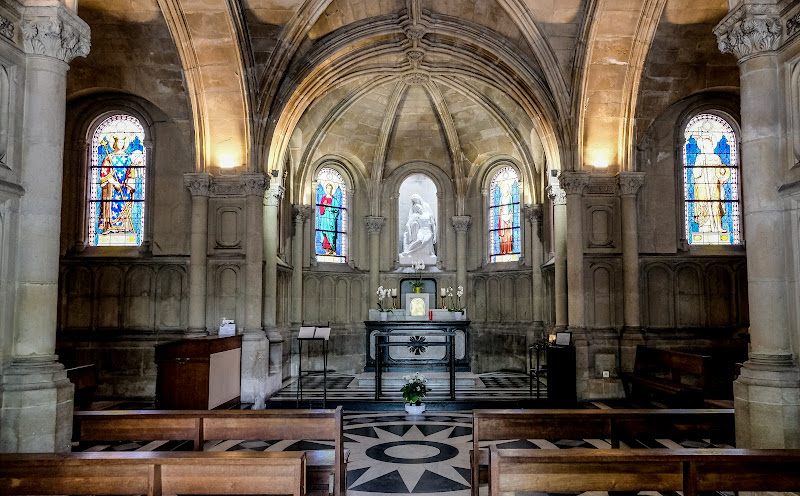
Église Notre-Dame-de-Compassion
Église Notre-Dame de Compassion is a Paris Attractions landmark located in the 17 arrondissement. Royal memorial chapel where tragedy created sacred architecture At Place du Général Koenig in the 17th arrondissement, Église Notre-Dame-de-Compassion stands as an extraordinary memorial chapel built in 1842-43 to honor Ferdinand Philippe, Duke of Orléans, heir to King Louis-Philippe, who died […]
Église Notre-Dame de Compassion is a Paris Attractions landmark located in the 17 arrondissement.
Royal memorial chapel where tragedy created sacred architecture
At Place du Général Koenig in the 17th arrondissement, Église Notre-Dame-de-Compassion stands as an extraordinary memorial chapel built in 1842-43 to honor Ferdinand Philippe, Duke of Orléans, heir to King Louis-Philippe, who died in a carriage accident while traveling to Neuilly. Designed by Pierre François Fontaine and completed by Pierre Bernard LeFranc in neo-Byzantine style modeled after Ravenna’s ancient Mausoleum of Galla Placidia, this unique sanctuary demonstrates how personal tragedy can inspire architectural achievement that serves both private grief and public spiritual consolation through memorial buildings that transcend immediate mourning to become pilgrimage sites for all who experience loss.
Queen’s grief and architectural commemoration
The dedication to the Virgin Mary as patron of accidental death victims extends the chapel’s significance beyond royal mourning to embrace all families experiencing sudden loss, demonstrating how personal grief can inspire institutional charity when memorial architecture serves broader community spiritual needs rather than exclusive dynasty honor through sacred spaces that welcome all who seek comfort in shared human vulnerability.
Eclectic architectural synthesis and stylistic innovation
The Greek cross plan provides intimate sacred space that encourages personal prayer while accommodating larger memorial services, where architectural proportion creates appropriate scale for both individual grief and communal mourning through spatial design that balances private spiritual encounter with public ceremonial function required for memorial architecture serving both family remembrance and community spiritual support.
Artistic collaboration and memorial artistry
This artistic integration proves that memorial architecture achieves optimal emotional impact when visual arts combine to create environments where beauty serves healing through stained glass light, sculptural presence, and architectural proportion that together create sacred atmosphere capable of transforming grief into spiritual comfort through artistic excellence that elevates mourning toward transcendent encounter with divine compassion for human suffering.
Urban development and architectural preservation
The transition from royal memorial chapel to 1993 parish church illustrates how memorial architecture can evolve to serve broader community spiritual needs while maintaining original commemorative purpose, where buildings designed for dynasty grief can expand their mission to serve ongoing parish worship through adaptive use that honors memorial origins while embracing contemporary liturgical functions that serve living faith communities seeking spiritual guidance within memorial spaces consecrated by royal tragedy transformed into universal comfort.
Contemporary ministry and parental consolation
The 1929 Historic Monument designation and continued active parish function create perfect synthesis of cultural preservation and spiritual service, where architectural heritage protection enables ongoing memorial ministry that proves the finest commemorative buildings achieve immortality through continuous spiritual service rather than mere historical museum status, creating sacred spaces where contemporary grief can encounter historical memorial wisdom through environments consecrated by royal tragedy transformed into universal spiritual resource.
Essential information
- Original purpose: Memorial for Duke Ferdinand Philippe d’Orléans (d. 1842)
- Architects: Pierre François Fontaine, completed by Pierre Bernard LeFranc
- Construction: 1842-1843
- Location: Place du Général Koenig, 17th arrondissement
- Architectural style: Neo-Byzantine with eclectic elements
- Relocation: 1970 (stone-by-stone for Palais des Congrès)
- Parish status: 1993
- Historical monument: 1929
Artistic and spiritual significance
- Inspiration: Mausoleum of Galla Placidia, Ravenna (425-450 AD)
- Plan: Greek cross layout for intimate memorial worship
- Stained glass: Jean-Auguste-Dominique Ingres designs
- Sculpture: Henri de Triqueti cenotaph in Carrara marble
- Special ministry: Consolation for parents who have lost children
Royal tragedy creates universal spiritual sanctuary
Église Notre-Dame-de-Compassion embodies the transformative power of royal grief channeled into memorial architecture that serves universal human experiences of sudden loss, where Queen Marie-Amélie’s proposal created a chapel that transcended dynastic mourning to become a sacred refuge for all families confronting accidental death and unexpected tragedy. This extraordinary memorial proves that authentic commemorative architecture emerges when personal suffering generates institutional charity through buildings that serve both individual remembrance and community spiritual healing, creating sacred spaces where grief encounters divine compassion through environments designed to transform tragedy into spiritual growth. For memorial architecture enthusiasts, royal history admirers, or anyone seeking spiritual comfort after loss, this relocated chapel offers an unparalleled encounter with architectural consolation, where Ingres stained glass and Triqueti sculpture create artistic environments that prove the finest memorial buildings achieve immortality through ongoing spiritual service rather than mere historical preservation, demonstrating that royal tragedy can generate lasting benefit when individual suffering inspires institutional creation that serves universal human needs for sacred spaces where grief can encounter divine comfort through memorial architecture that honors specific loss while embracing all who require spiritual healing within environments consecrated by authentic sorrow transformed into enduring compassion.