
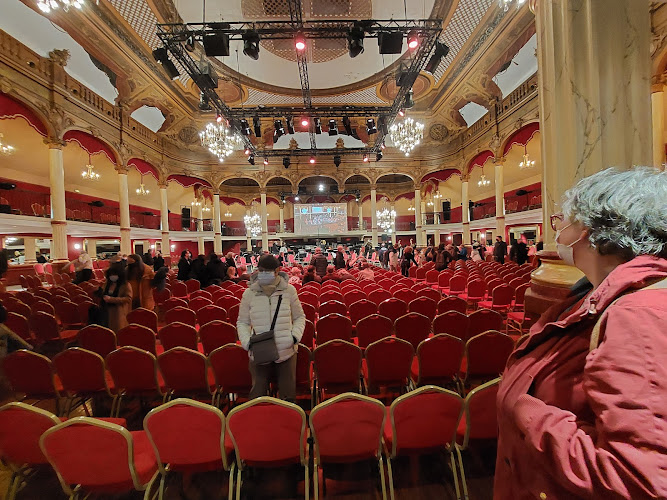
Salle Wagram
Salle Wagram is a Paris Salle De Réception landmark located in the 17 arrondissement. From Imperial ballroom to legendary recording studio Located in the elegant 17th arrondissement at 39-41 avenue de Wagram, Salle Wagram stands as one of Paris’s most distinguished cultural venues, where Second Empire grandeur meets contemporary event sophistication. This historic auditorium, originally […]
Salle Wagram is a Paris Salle De Réception landmark located in the 17 arrondissement.
From Imperial ballroom to legendary recording studio
Located in the elegant 17th arrondissement at 39-41 avenue de Wagram, Salle Wagram stands as one of Paris’s most distinguished cultural venues, where Second Empire grandeur meets contemporary event sophistication. This historic auditorium, originally built in 1812 as the Bal Dourlans and reconstructed in 1865, has witnessed over two centuries of Parisian cultural life, evolving from imperial ballroom to legendary classical recording venue to modern celebration space.
Imperial origins and architectural grandeur
The original Bal Dourlans, designed by architect Adrien Alphonse Fleuret in 1812, was conceived as a grand ballroom worthy of the imperial capital. The reconstruction in 1865 created the magnificent space we know today, featuring soaring ceilings, ornate chandeliers, and intricate decorative elements that embody the opulence of Second Empire Paris.
The venue’s architectural design reflects the period’s belief that public spaces should inspire through beauty and scale. The grand ballroom, with its elegant proportions and rich decorative program, was designed to elevate social gatherings from mere entertainment to cultural celebrations worthy of the world’s most sophisticated capital.
Stage for international prestige
Throughout its history, Salle Wagram has served as the setting for events of international significance, hosting congresses, political conferences, fashion exhibitions, and dance competitions that brought together global elites. The venue’s prestige made it a natural choice for occasions requiring both architectural grandeur and logistical sophistication.
The hall’s reputation for excellence attracted not only political and social events but also cultural gatherings that helped define Parisian taste and influence. Its role in international diplomacy and cultural exchange established Salle Wagram as more than an event space—it became a symbol of French cultural leadership.
Golden age of classical recording
From the 1950s onward, Salle Wagram achieved legendary status as one of the world’s premier classical recording venues. Its exceptional acoustics attracted the greatest artists of the era, including the Paris Conservatoire Orchestra conducted by Carl Schuricht for complete Beethoven symphony cycles, and Pierre Monteux directing Stravinsky ballets.
The venue’s most famous recording sessions featured opera legend Maria Callas in the complete Carmen, alongside tenor Nicolai Gedda. In the 1990s, Salle Wagram continued its recording tradition with the French National Orchestra’s acclaimed Poulenc recordings, cementing its reputation as a temple of classical music excellence.
Modern event destination with historic soul
Today’s Salle Wagram operates as a sophisticated event venue while maintaining its architectural heritage and cultural significance. Listed as a historic monument since March 2, 1981, the venue comprises two magnificent spaces of 800 and 600 square meters respectively, offering flexibility for events ranging from intimate gatherings to grand celebrations.
The venue’s modern capabilities include state-of-the-art technical systems for conferences, exhibitions, and performances, while preserving the ornate chandeliers, decorative moldings, and elegant proportions that made it famous. This balance ensures that contemporary events benefit from both modern functionality and historic atmosphere.
Continuing cultural legacy
Salle Wagram’s transformation from imperial ballroom to recording studio to modern event venue demonstrates how great architecture can adapt to serve successive generations while maintaining its essential character. The venue continues to attract prestigious events that require both practical excellence and cultural prestige.
The hall’s enduring appeal lies in its unique combination of historical significance, architectural beauty, and acoustic excellence—qualities that made it perfect for imperial balls, classical recordings, and contemporary celebrations alike.
Essential information
- Original construction: 1812 (as Bal Dourlans)
- Reconstruction: 1865
- Architect: Adrien Alphonse Fleuret
- Heritage status: Listed historic monument (March 2, 1981)
- Location: 39-41 avenue de Wagram, 17th arrondissement
- Current capacity: Up to 1,300 for cocktail events
- Space: Two halls of 800m² and 600m² (1,600m² total)
Cultural significance
- Recording legacy: Home to legendary classical recordings with Maria Callas, Paris Conservatoire Orchestra
- Event prestige: Venue for international congresses, fashion shows, cultural celebrations
- Architectural style: Second Empire grandeur with ornate chandeliers and decorative elements
- Acoustic excellence: Renowned for superior sound quality in both performance and recording
- Modern facilities: Contemporary technical capabilities within historic architecture
Timeless elegance
Salle Wagram represents more than just a beautiful venue—it embodies the continuity of Parisian cultural excellence across multiple centuries. From imperial ballroom to classical recording temple to modern event destination, this remarkable space demonstrates how great architecture can serve different purposes while maintaining its essential dignity and character. For visitors attending events at Salle Wagram, every gathering takes place within walls that have witnessed the full sweep of Parisian cultural history, where the echoes of imperial celebrations, classical masterpieces, and contemporary achievements blend beneath chandeliers that have illuminated two centuries of French cultural life.