
Brasserie Mollard is one of the oldest brasseries in Paris, a listed Art Nouveau seafood brasserie at 115 rue Saint-Lazare in the 8th arrondissement, near Saint-Lazare train station. It opens every day of the year from noon, serves without an afternoon break, and prices its set menus at €31.25 for two courses and €41.30 for three. The 1895 dining room, registered as a historic monument since 1989, is the reason most people come; the cooking is competent traditional brasserie food that draws praise and complaint in roughly equal measure.
Paris Top Ten may earn a commission from booking links on this page. That never changes what we write or which places we recommend.
Brasserie Mollard at a glance
Address | 115 rue Saint-Lazare, 75008 Paris (8th arrondissement) |
Nearest station | Saint-Lazare – metro 3, 12, 13, 14; Havre-Caumartin – metro 3, 9 |
Reservations | +33 1 43 87 50 22 |
Information | +33 1 43 87 55 62 |
Hours | Daily, all year, from noon. Continuous service, no afternoon break |
Open on holidays | Yes – including 25 December, 1 January and 1 May |
Cuisine | Traditional French, weighted to fish, shellfish and seafood |
Set menus | €31.25 (two courses) to €89.90 (lobster menu) |
A la carte average | €40 to €60 per person |
Built | 1895, by architect Edouard-Jean Niermans |
Heritage status | Registered historic monument since 9 November 1989 (ref. PA00088884) |
Owner | Joel Prodhomme; the business is independent |
Quality label | Maitre Restaurateur since 2014 |
Accessibility | Wheelchair accessible; accessible WC with grab handle |
Air conditioning | Yes |
What is Brasserie Mollard known for?
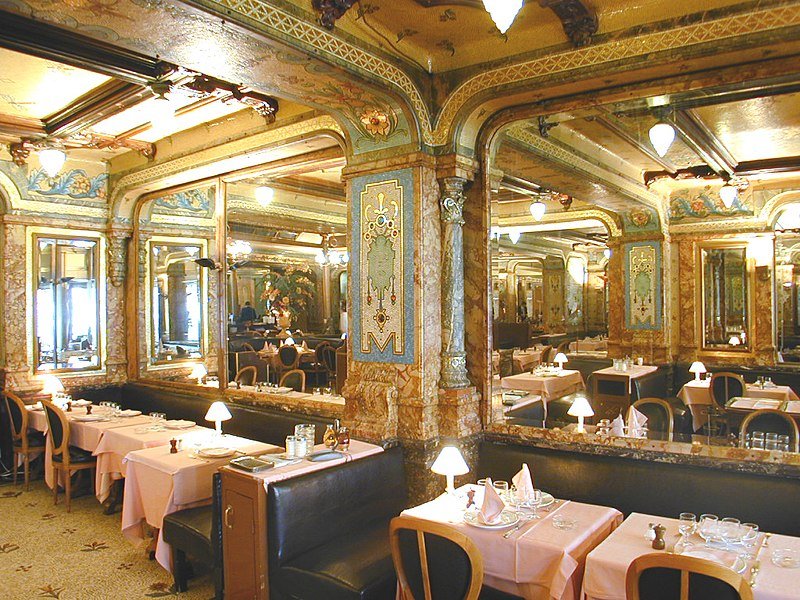
Mollard is known for its Art Nouveau decor, one of the most complete surviving 1900 schemes in Paris, and for seafood. The Paris Convention and Visitors Bureau files it as a gourmet institution and Visit Paris Region calls the building an architectural jewel. The 1895 room combines ceramics, mosaics shipped from Italy, glazed faience panels made to order by the Sarreguemines works, and columns and ceilings finished in enamelled tiles from Briare with flower and insect motifs. The panels are not decorative abstractions: each one shows a scene from life around Gare Saint-Lazare, which is what the station’s trains served. Deauville, Saint-Germain-en-Laye and Ville-d’Avray appear, along with the station entrance and exit, a Belle Epoque pleasure party, and Alsace and Lorraine, provinces France had lost in 1871 and had not stopped mourning by 1895.
The kitchen’s identity follows from the address. Saint-Lazare took the trains from Normandy, so the brasserie built itself around what came off them, and it still lists itself as a house of fruits de mer, crustacés, poissons. Oysters, whole lobster from the tank, fish soup and shellfish platters are the core; the beef and duck are there for the people who came for the room.
Where is Brasserie Mollard and how do you get there?
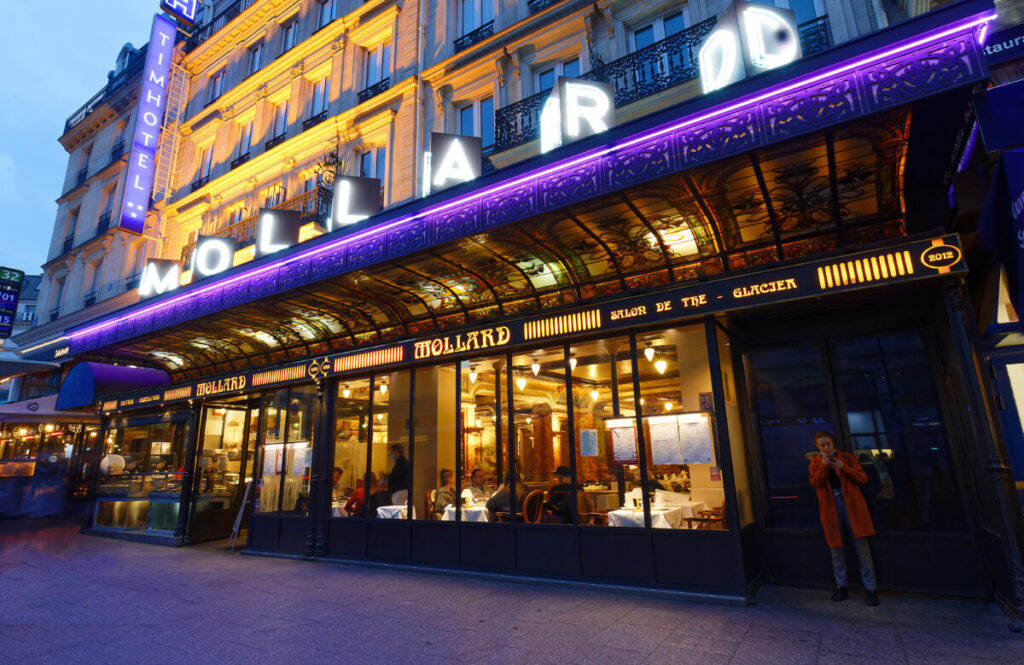
Brasserie Mollard is at 115 rue Saint-Lazare, 75008 Paris, on the north side of the street facing Gare Saint-Lazare. It is a two-minute walk from the station concourse, about five minutes from Printemps and Galeries Lafayette on boulevard Haussmann, and roughly ten from the Palais Garnier opera house. The off-white facade and its tall picture windows sit under blue and yellow neon, which is the easiest landmark at night. Note that some listings place Mollard on rue de Rome, which is the street the station car park sits on, not the restaurant’s address.
Mode | Line or service | Stop |
|---|---|---|
Metro | 3, 12, 13, 14 | Saint-Lazare |
Metro | 3, 9 | Havre-Caumartin |
RER | A | Auber |
RER | E | Haussmann Saint-Lazare |
Bus | 20, 21, 22, 24, 26, 27, 28, 29, 32, 43, 53, 66, 80, 81, 94, 95 | Gare Saint-Lazare |
Car park | Parking Saint-Lazare | rue de Rome |
Car park | Parking Haussmann-Printemps | rue du Havre |
Car park | Malesherbes-Anjou | 35 boulevard Malesherbes |
What are Brasserie Mollard’s opening hours?
Mollard opens every day of the year from midday, with continuous service and no afternoon closure. The closing time is the one detail its own channels and the tourist boards do not agree on: mollard.fr and the brasserie’s Instagram both state noon to midnight, while the Paris Convention and Visitors Bureau and Visit Paris Region both list noon to 12:30 am. Treat midnight as the safe assumption for a late arrival and call ahead if you want a table after 10 pm.
Continuous service is the practical reason to keep this address in mind. Most Paris kitchens shut between roughly 14:30 and 19:00, which strands anyone arriving off a mid-afternoon train. Mollard does not, and it stays open on 25 December, 1 January and 1 May, three dates when a large share of central Paris restaurants close entirely.
How much does it cost to eat at Brasserie Mollard?
The cheapest complete meal is €31.25 for two courses, and the three-course carte menu is €41.30. Ordering freely from the main list works out at €40 to €60 a head before wine, according to the Paris Convention and Visitors Bureau. The lobster menu at €89.90 is the ceiling among the published set menus. Several dishes inside the set menus carry a €3 supplement, marked on the menu itself, and the oysters, foie gras, fish choucroute and grilled rib of beef are the usual ones.
Menu | Price | What it includes |
|---|---|---|
Formule Express | €31.25 | Dish of the day plus a glass of wine |
Formule Autour d’un Plat | €31.25 | Starter and main, or main and dessert |
Formule Apres Spectacle | €36.85 | Kir or a glass of wine, then two courses |
Menu Carte | €41.30 | Starter, main and dessert from the full choice |
Menu Autour du Homard | €89.90 | A roughly 500 g lobster from the tank, grilled, thermidor or americaine, with a starter or dessert |
Supplement | +€3 | Applies to marked dishes inside the set menus |
A la carte average | €40 to €60 | Per person, food only |
One correction is worth making plainly, because this page carried the error for years: the €41.30 carte menu does not include a drink, and Mollard publishes no children’s menu. If you are budgeting for a family, price the children as adults or plan around the express formula.
What food does Brasserie Mollard serve?
Mollard cooks traditional French cuisine in the brasserie register, with the weight on fish and shellfish, and both Paris tourist boards describe the kitchen as doing justice to French gastronomy. The published starter list runs to fine de claire and Blanche de Bretagne oysters, a tasting plate mixing claires, belons and blanches, marinated salmon with dill, green asparagus with spiced crab, pan-fried gambas, six snails in garlic butter, gratinated onion soup, house duck foie gras and the house Salade Saint-Lazare.
Main courses include grilled salmon, a fish fricassee, trout meuniere, braised grouper fillet, a fish choucroute, confit duck leg, grilled AAAAA andouillette, grilled rib of beef and steak tartare made to your specification. The dessert to order is the Omelette Surprise Mollard, the house baked Alaska, which the restaurant has been serving since a 1950s all-you-can-eat version at ten francs made the place famous a second time.
Since 2014 the kitchen has held the state Maître Restaurateur title, which requires that dishes be made on the premises from raw ingredients rather than assembled from bought-in preparations. It is a supply-chain guarantee rather than a rating, and it is a fair reason to expect the classics to be honest even when a review says the seasoning was not.
What do reviews say about Brasserie Mollard?
Reviews split sharply along one line: the room is admired almost universally, the cooking is not. TripAdvisor rates Mollard 3.5 out of 5 across 2,592 reviews and ranks it 5,378th of 16,781 Paris restaurants, which is a middling position for a listed monument on a prime corner. Reviewers who order shellfish tend to be the happiest, and the seafood platter draws the strongest recommendations. Reviewers who order a hot main course are the ones who report inconsistency, and a French dining critic who ate here published a verdict of “too inconsistent” after an undercooked monkfish.
Source | Score | Sample | What it measures |
|---|---|---|---|
TripAdvisor | 3.5 / 5 | 2,592 reviews | Mostly visitors; ranked 5,378 of 16,781 in Paris |
Instagram following | — | 9,293 followers | Direct audience, not a quality signal |
Maitre Restaurateur | Held since 2014 | State inspection | Cooking on site from raw ingredients |
Historic monument | Registered 1989 | Ref. PA00088884 | The interior, not the food |
The recurring complaints are worth naming rather than smoothing over. Service is brisk and formal in the old brasserie manner, which reads as efficient to some diners and as indifferent to others. Portions and seasoning vary between visits. The room is large and the acoustics are hard, so a full evening service is loud. None of that is hidden; it is what a century-old high-turnover brasserie beside a mainline station is.
Is Brasserie Mollard a tourist trap?
No, but it is a monument that also feeds people, and the distinction matters when you book. A tourist trap sells a location at a premium and cuts the kitchen; Mollard, among the oldest brasseries in the capital, charges €31.25 for two courses, holds a state cooking label, and is still independently owned rather than absorbed into one of the brasserie groups that now run much of the category in Paris. What it is not is a destination for cooking alone. If you would be disappointed by a competent plate of shellfish in an extraordinary room, this is the wrong booking.
The honest comparison is with the other listed brasseries in the same bracket, including Brasserie Lipp in Saint-Germain. They are bought for the same reason and judged on the same terms.
Why is the Mollard dining room a listed monument?
The interior was registered on the supplementary inventory of historical monuments on 9 November 1989, under reference PA00088884. What earned the listing is the completeness of an 1895 Art Nouveau style scheme designed as a single object. Edouard-Jean Niermans, assisted by Eugene Martial Simas, controlled the whole build: he drew the mosaic cartoons himself and designed the chairs, the tables, the light fittings, the coat racks and the cashier’s desk. Many of the mosaics and faience panels carry Simas’s signature.
Niermans was the architect the Belle Epoque hired when it wanted a room to be an event. His other work includes the Hôtel Negresco in Nice, the Hôtel de Paris in Monte-Carlo, the Moulin Rouge, the Folies Bergère and the Angelina tea room on rue de Rivoli. Mollard is the most intact survivor of that group in Paris.
The listing is an inscription, the second tier of French heritage protection, not a classement. That distinction gets flattened to “classified” in most English write-ups, including several that outrank this page.
What is the history of Brasserie Mollard?
Mr and Mrs Mollard arrived in Paris from Savoie in 1867 and opened a counter opposite the station. He delivered coal; she poured wine, beer and absinthe for railway workers and passengers. Thirty years of that paid for the building. In 1895 they commissioned Niermans, and the Maison Mollard reopened as the most fashionable dining room in the most modern quarter of the city, its arrival announced in the newspaper Gil Blas.
The interesting part of the story is what happened next, because the received version on most pages skips it. The First World War removed the clientele the room had been built for and the business declined. Judging the decoration old-fashioned, the management covered almost all of it with paint and large mirrors. The central glass roof collapsed in 1920. The Gauthier family bought the brasserie in 1928 and carried it through the 1930s downturn; under the Occupation it kept a queue of neighbours fed. Post-war it turned into an unofficial office for Rouen and Le Havre businessmen who had lost their Paris premises and held meetings over aperitifs two days a week.
The paint saved the room. When the owners commissioned the renovation in 1965 and stripped the paint back, almost the entire 1895 scheme was intact underneath, protected by fifty years of concealment. Every major fresco was restored and only one was lost. The sea-green, royal blue, gilt and marble palette visible today is that recovered decoration, not a reconstruction. A small pink lounge and the two private rooms are modern additions, and the facade was reworked between 2011 and 2013 to a design by the interior architect Philippe André.
What is the difference between a brasserie and a restaurant?
A brasserie serves a fixed menu continuously through the day and takes walk-ins; a restaurant serves defined lunch and dinner sittings and usually expects a reservation. The word means “brewery”, and the format arrived in Paris with Alsatian brewers after 1871, which is why choucroute and beer remain on brasserie menus that otherwise sell shellfish.
Mollard fits the definition exactly. It runs one carte from midday to midnight without a break, seats people who walk in off a train, and keeps the Alsatian inheritance visible on the plate in the fish choucroute and in the mosaics on the wall.
What else does Brasserie Mollard offer?
Two private rooms, “Hivers” and “Les Trois Saisons”, are grouped as les Jardins de l’Isly. Both are modular, air-conditioned and lit by natural daylight, and the brasserie takes bookings for family meals, meetings and seminars for up to 250 people. The main dining room is also air-conditioned, which is not a given in a listed 19th-century interior and matters in a Paris August.
The restaurant is accessible to self-propelled wheelchairs and has an accessible toilet with a grab handle and turning space. Menus are stocked in English, German, Spanish, Italian, Chinese, Japanese and Russian as well as French, though the floor staff work in French. Amex, Visa, Mastercard, Diners Club and JCB are all accepted.
Five mistakes to avoid at Brasserie Mollard
- Arriving without a booking on a weekday evening. The room is big, but it sits opposite one of the busiest railway stations in Europe and fills from it. Call +33 1 43 87 50 22.
- Budgeting €40 for a full evening. That figure covers food only at the lower end of the carte. Add wine and the marked supplements and a three-course dinner lands closer to €70 a head.
- Ordering the meat when the tank is the point. The shellfish, the oysters and the lobster are what the kitchen is built around, and they are what the strongest reviews describe.
- Looking for it on rue de Rome. That is the car park street behind the station. The entrance is on rue Saint-Lazare, under the blue and yellow neon.
- Booking a quiet dinner. Hard surfaces, high ceilings and a full house make this a loud room after 20:00. Ask for the small pink lounge or come at lunch if you need to hear each other.
Who should book Mollard, and who should skip it
Book it if you want to eat inside a piece of 1895 design rather than look at one behind a rope; if you are catching or meeting a train at Saint-Lazare and need a kitchen that is open at 16:00; if you are in Paris on 25 December or 1 January; if you want oysters and a whole lobster without a fine-dining bill; or if you are shopping the boulevard Haussmann stores and want lunch two streets away.
Skip it if the cooking has to be the best part of the evening, if you want a quiet table, or if you are travelling with children and need a dedicated menu. For a wider set of options in the same city, see our guide to the best restaurants with a view of the Eiffel Tower or read about the covered passages and galleries a short walk south.
Corrections made to this page
This review previously carried several errors. They are listed here rather than quietly deleted, because other pages repeat them.
- The address was given as rue de Rome. Mollard is at 115 rue Saint-Lazare.
- The founding date was given as 1912 in one paragraph and implied as 1885 in another. The family arrived in 1867 and the brasserie as it stands was built in 1895.
- The mosaics were described as maps of France. They are scenes of life around Gare Saint-Lazare, executed in Italian mosaic and Sarreguemines faience.
- Opening hours were given as 11:00 to 12:30 am. Service starts at midday.
- A complete meal was priced at “around 40 euros, drink included”, with a children’s menu at 12 euros. The €41.30 carte does not include a drink and no children’s menu is published.
- The menu was described as quiches, tarts, roast chicken and sandwiches. None of those appear on the published carte, which is built on shellfish and fish.
- A section headed “Ratings and Reviews” contained a first-person account of a visit and no rating, no source and no number. It has been replaced with sourced figures.
- An image of the dining room at a different Paris hotel was captioned and published on this page. It has been removed.
Frequently asked questions
Where is Brasserie Mollard?
Brasserie Mollard is at 115 rue Saint-Lazare, 75008 Paris, in the 8th arrondissement, directly opposite Gare Saint-Lazare. The nearest metro is Saint-Lazare on lines 3, 12, 13 and 14, with Havre-Caumartin on lines 3 and 9 a few minutes further. It is not on rue de Rome, which is where the station car park sits.
What are Brasserie Mollard’s opening hours?
Mollard opens every day of the year from midday, with continuous service and no afternoon break. Its own website and Instagram give midnight as the closing time; the Paris Convention and Visitors Bureau and Visit Paris Region both list 12:30 am. It also stays open on 25 December, 1 January and 1 May.
How much does a meal at Brasserie Mollard cost?
Set menus run from 31.25 euros for two courses to 41.30 euros for three, with a lobster menu at 89.90 euros. Eating from the carte averages 40 to 60 euros per person before wine. Some dishes inside the set menus carry a 3 euro supplement, and the carte menu does not include a drink.
Do you need to book a table at Brasserie Mollard?
Walk-ins are part of the brasserie format and the room is large, but book ahead for weekday evenings, for groups and for the private rooms. Reservations go through +33 1 43 87 50 22; the separate information line is +33 1 43 87 55 62.
What is Brasserie Mollard known for?
Its 1895 Art Nouveau decor, registered as a historical monument since 1989, and its shellfish. The room combines ceramics, Italian mosaics and Sarreguemines faience panels showing scenes of life around Gare Saint-Lazare, with columns and ceilings in Briare enamel. The kitchen is built on oysters, lobster and fish.
Is Brasserie Mollard worth eating at?
For the room and the shellfish, yes. TripAdvisor rates it 3.5 out of 5 across 2,592 reviews and ranks it 5,378th of 16,781 Paris restaurants, and the recurring criticism is inconsistent hot dishes rather than poor sourcing. It has held the state Maitre Restaurateur label since 2014, meaning dishes are cooked on site from raw ingredients.
Is Brasserie Mollard wheelchair accessible?
Yes. Visit Paris Region lists Mollard as accessible to self-propelled wheelchairs, with an accessible toilet fitted with a grab handle and enough space to turn. The dining room is also air conditioned.
How we checked this
The address, both telephone numbers, opening hours, set menu prices and the seafood specialization were read from mollard.fr in August 2026; the menu page was last revised in June 2024, so confirm prices when you book. The a la carte average, the owner’s name, the payment cards, the metro lines and the confirmation that the brasserie opens on 25 December, 1 January and 1 May come from the Paris Convention and Visitors Bureau listing. Bus routes, car parks, menu languages and the accessibility detail come from Visit Paris Region. The 1867 arrival, the 1895 build, the architect and his collaborator, the 1920 roof collapse, the 1928 sale, the 1965 restoration and the 2011 to 2013 facade work follow the sourced French-language record and the brasserie’s own account of its decoration, which agree. The heritage reference PA00088884 is the French Ministry of Culture’s Merimee entry. Ratings were read from the live TripAdvisor listing in August 2026. Where a claim carried on this page could not be substantiated, it was removed and listed in the corrections above rather than rewritten into something vaguer.
Last updated 8 August 2026. This revision corrected the street address, the founding date, the description of the mosaics, the opening hours, the price of a meal, the menu itself and the ratings section, removed a photograph of a different restaurant, and added the first published prices, telephone numbers, metro lines, accessibility details and heritage reference this page has carried.
Related reading
- The most beautiful squares in Paris
- Hotel du Nord Le Pari Velo review
- The best time to visit Paris
- Experiences worth booking in France
- Things to do in Paris