
Whether you call it the Louvre Pyramid or the Glass Pyramid, there’s no denying this iconic structure is one of a kind.
A pyramid positioned in the center of a courtyard — something like this isn’t precisely what you’d expect to see when first visiting the Louvre. But then again, this museum isn’t just your run-of-the-mill art museum. It’s vast. It’s got priceless art pieces.
It’s probably one of Paris’s most popular tourist attractions, with more than 9 million annual visitors (and growing). So, we’re guessing that more than a few people are curious about its iconic glass pyramid.
In this article, we’ll give you information about the history, features, and other details of the glass pyramid at The Louvre. Hop on!
What is the Louvre Glass Pyramid, and where is it located?
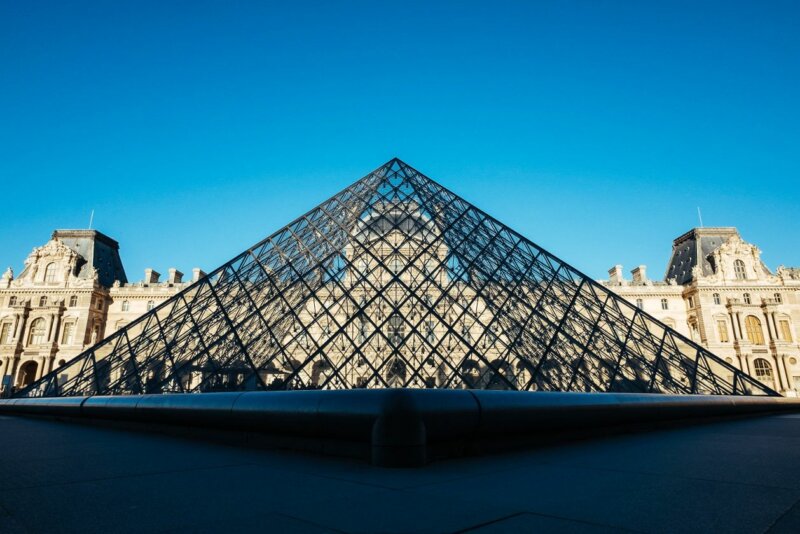
The Louvre Pyramid is a huge glass triangular prism that sits in the center of the courtyard at the Louvre Museum on the Right Bank of the River Seine in Paris, France.
The Louvre Pyramid was constructed as part of the Le Grand Louvre project, an initiative to expand and renovate the museum to make it more accessible and attractive for visitors. The pyramid is in front of the museum’s entrance, so it’s among the first sights you’ll notice upon entering the museum.
The structure was created by architect Ieoh Ming Pei (who also made famous structures such as The Rock & Roll Hall of Fame and Museum). The pyramid was made accessible to the general public in March 1989 in a massive reconstruction plan for the Museum. The proportions of the pyramid are similar to The Great Pyramid at Giza. It is one of the most impressive structures in Paris.
Key Features
Aspect | Details |
|---|---|
Location | Cour Napoléon, Louvre Palace, Paris, France |
Architect | I. M. Pei |
Commissioned by | President François Mitterrand in 1984 |
Completed | 1989 |
Height | 21.6 meters (71 feet) |
Structure | Self-supporting, with no pillars |
Materials | 95 tons of steel, 105 tons of aluminum, and 673 glass segments (lozenges) |
Total Glass Surface Area | Approximately 1,254 square meters (13,500 square feet) |
Purpose | Serves as the main entrance to the Louvre Museum, provides natural light to the underground lobby |
Controversy | Initially criticized for its modern design in contrast to the classic Louvre Palace architecture |
Inspiration | Designed to provide a contemporary spin while acting as a central focal point |
History of the Louvre Pyramid
When was it built?
The construction of the Louvre Pyramid is a part of the Grand Louvre, a 10-year project begun in 1981 by French President Francois Mitterrand. Ieoh Ming Pei was hired in 1983 to design a new grand entrance and reorganize the museum’s interior to accommodate the growing number of visitors.
The building was finished in late 1987. On October 14, 1988, the open space surrounding the pyramid was renamed Cour Napoléon and opened to the public. The pyramid, as well as the vast lobby beneath it known as Hall Napoléon and the underground complex, were inaugurated on March 29, 1989, and opened to the public on April 1, 1989.
Why was it placed at the entrance of the Louvre Museum?
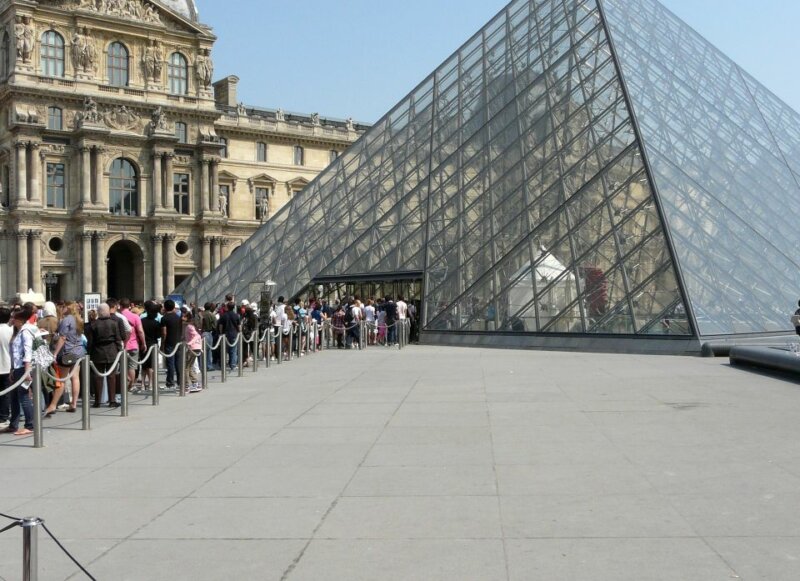
After studying the Louvre, which was in disrepair then, Pei devised a plan to build a new entrance in the Cour Napoléon, an exterior courtyard surrounded by the museum’s existing structures. He also considered constructing new underground infrastructure to create a functional and welcoming reception area and a system of public spaces and circulation to allow visitors access to the collections.
The new entrance would be in the courtyard’s center, marked by a translucent sculptural gesture defining the visitor’s arrival while lighting up the underground addition and respecting the historic structures.
See Related: Winters in France: A Comprehensive Guide to the Season
The design and structure of the Louvre Pyramid
The Louvre pyramid, used as an entrance in the Louvre’s courtyard, has roughly the same proportions as the Great Pyramid of Giza. The main pyramid also serves as a reminder of the importance of the museum’s Egyptian antiquities collection. The pyramids’ glass panes are made of rhomboid and triangular cuts, creating the illusion of cut jewels.
I. M. Pei designed the Louvre Pyramid so visitors would enter the pyramid, descend into the spacious lobby, and proceed to the main Louvre buildings.
Who designed and built the Louvre Pyramid?
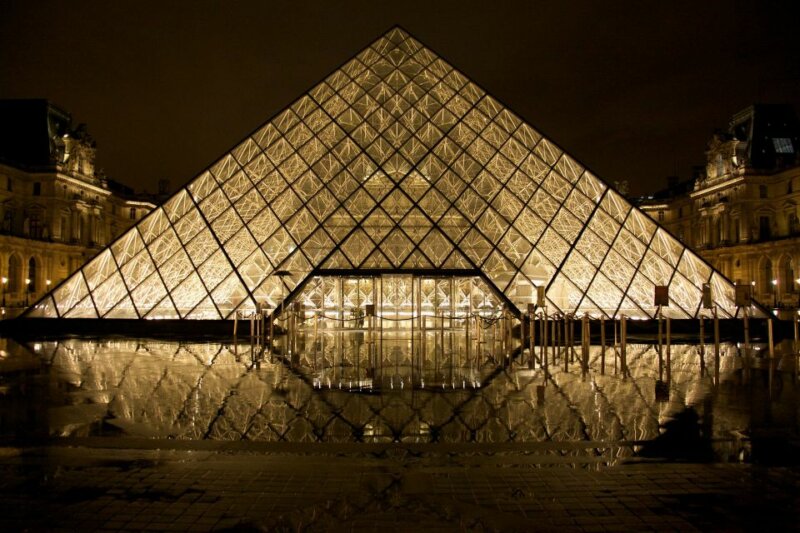
Francois Mitterrand chose the Chinese-American architect I.M. Pei, who was then President of France. In 1983, the Louvre Pyramid was designed by I.M. Pei (who also designed the Rock and Roll Hall of Fame and Museum).
The pyramid structure was designed by Nicolet Chartrand Knoll Ltd. of Montreal (Pyramid Structure / Design Consultant) and Rice Francis Ritchie of Paris (Pyramid Structure / Construction Phase).
VINCI, a French construction company, built the museum’s underground entrance, restaurants, auditorium, exhibition rooms, warehouses, a bookstore, and the base of Pei’s famous glass pyramid.
See Related: Naga Thai Spa
Why is it a pyramid?
Building a larger area above ground near the museum was impossible, so I.M. Pei and his team created an underground site with an above-ground grand entrance. They experimented with different shapes, but the Louvre’s silhouette had no curve, so the pyramid was the best fit.
The glass pyramid was created to add a modern twist to the surroundings while serving as a focal point. The contemporary structure, however, is meant to complement rather than detract from the museum’s traditional nature.
See Related: Best Farmers Markets in Paris: A Comprehensive Guide
What is it made of?
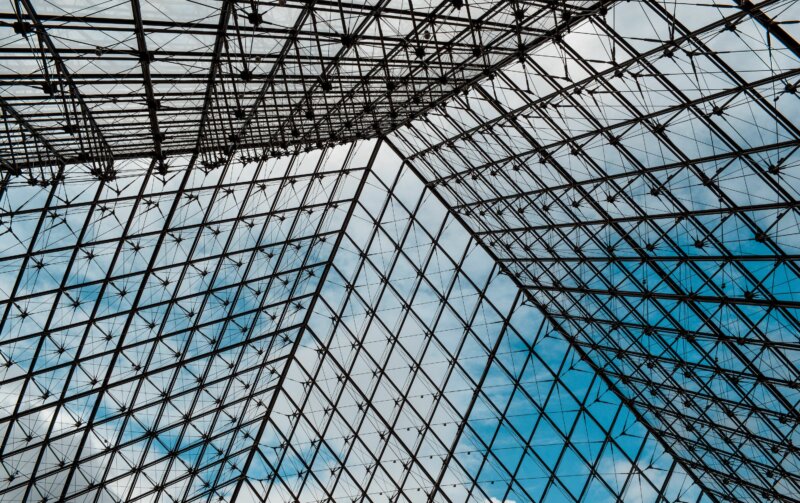
I.M. Pei designed the metal framework for the Louvre Pyramid. Pei desired a certain presence without going overboard. He wanted it to match the color of the existing buildings’ roofs, which turned out to have 11 shades of gray. They had several discussions to determine which shade of gray to use.
The main Louvre Glass Pyramid consisted of 673 panes (603 rhomboid and 70 triangular glass segments) and metal poles weighing 95 tons of steel and 105 tons of aluminum. There are 171 panes on three sides and 160 on the fourth side, which houses the pyramid’s entrance.
What are the dimensions of the Louvre pyramid?
The pyramid stands approximately 116 feet wide and 70 feet (21.6 meters) tall, with a base surface area of 1,000 square meters.
See Related: Mont St Michel Small Group Guided Day Tour from Paris
The Louvre Glass Pyramid as a tourist attraction
The Louvre Pyramid is now an iconic tourist attraction itself. Since 1993, the underground space under the Pyramid has been the museum’s main entrance.
How do you get to the Louvre Museum?
The Louvre is central and easy to travel to once in Paris.
Going by Paris Metro
By Paris Metro, the Louvre has its metro station on line 1 called Palais-Royal–Musee du Louvre. Ride the Metro, get off at the Palais Royal Musée du Louvre Metro station stop, and walk directly to the entrance.
Going by bus
The famous Paris Hop-on, Hop-off Sightseeing Buses stop here, and the Batobus river bus service also has a stop for the Louvre.
You can take other buses like buses 21, 69, 72, N11, or N24 to go to the Palais Royal – Musée du Louvre bus stop. From there, you can walk to the entrance.
Other options
If you purchase a day trip or guided tour, instructions are usually found on the product page on where to meet your tour guide and how to get there. If you plan to go to the museum, it is advisable to bring a map!
Is the Louvre Museum open all year?
No, it is not. The Louvre Museum is open from 9:00 AM TO 6:00 PM on Mondays, Wednesdays, Saturdays, and Sundays. On Fridays, it is open from 9:00 AM to 9:45 PM. The museum is closed on Tuesdays and public holidays (January 1, May 1, and December 25).
The museum allows entry until an hour before closing, and rooms are cleared 30 minutes before closing.
See Related: Art Museums in Paris
How long should I wait to get inside?
Suppose you’re getting in via the main pyramid. In that case, it may take more than an hour without reservations, depending on how crowded the venue is on the day of your visit.
When you reserve in advance, you can bypass the line and enter the museum in ten minutes.
Are there guided tours available?
Many guided tours are available, and they vary in what they offer. Check them out and see what fits your taste.
When is the best time of year to go there?
The busiest months of the Louvre Museum are June-September, so we recommend visiting in October-April when there are fewer visitors.
Free admission to some
Free admission to the Louvre is granted to people of certain ages, nationalities, and professions. You will find the list of visitors eligible for free admission on the official website of the Louvre Museum.
See Related: Tour à pied avec guide privée quartier latin + patisserie offerte 1h
What attractions are close to the Louvre Pyramid?
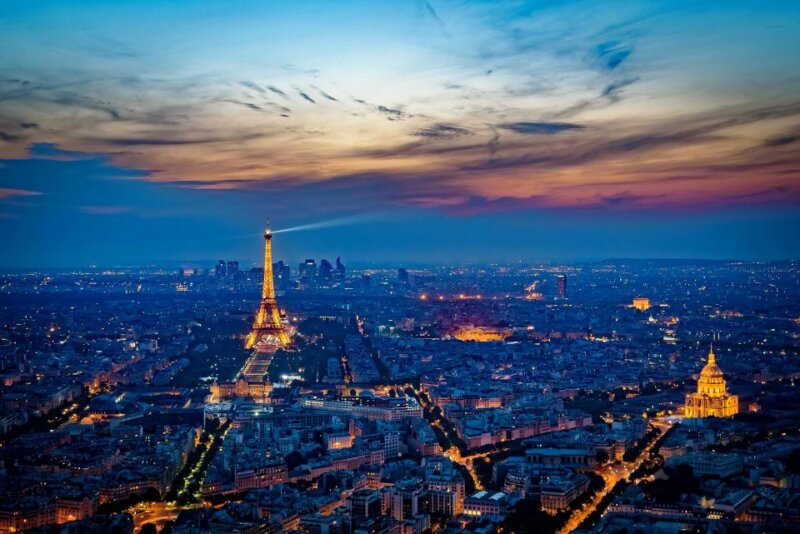
The Louvre is a short walk from Notre Dame and the Orsay Museum, taking about 5-10 minutes. It is located 4.3 kilometers (2.7 miles) from the Eiffel Tower on the other side of the Seine River. By taxi, this distance can be covered in about twelve minutes. The walking distance is approximately 3.5 kilometers (2.1 Miles). If you choose to walk, it will take you about 45 minutes.
See Related: Most Famous Historical Landmarks in Paris
Interesting Facts about the Louvre Pyramid
It was not well received on those days.
For several reasons, people hated the idea before it was even constructed. What is more about the early years of its construction?
They thought the pyramid was “an architectural joke.” They did not like the shape of the structure and the fact that it was modeled after a symbol of death in Egypt. They also hated that it was constructed by a Chinese-American architect who had no idea about French culture.
Worse, some theories about it having 666 glass panes circulated, which is the devil’s number. The fact is the pyramid consists of 673 glass segments.
I.M. Pei was so hated that he was publicly mocked and felt the people looking at him when he walked on the streets. Ian Bader, one of the architects who worked on the Louvre Glass Pyramid, recalled seeing a cartoon of all of Paris trapped inside the pyramid in a newspaper.
See Related: Bruges Small Group Guided Day Tour from Paris
The glass was difficult to find
I.M. Pei was not satisfied with the other kinds of glass. At first, he wanted a reflective glass, but nope. Then he tried the different types, but they reflect color – he didn’t like the structure to reflect color because it strengthened the perception of form.
Pei wanted the pyramid structure to look delicate and transparent. Then they looked for clear glass used in buildings but had a greenish tint. IM Pei wanted a clear glass that would not alter how people see the color of the surrounding building. They spent time making the perfect glass. Then, they doubled the weight to keep the structure stable.
See Related: Best Free Walking Tours in Paris, France
It is not the only entrance to the Louvre Museum.
Though the Pyramid entrance to the Louvre is famous, it is not the only way to enter the museum. It is sometimes preferable to take alternate routes to avoid crowds. Visitors with individual or group tickets may enter through Passage Richelieu.
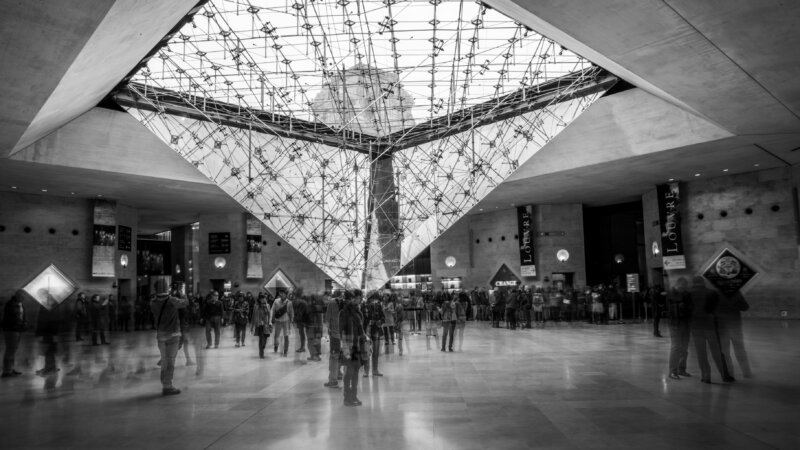
You can also enter through the Carrousel du Louvre, an underground shopping and dining area that opened in 1993. You can access the museum directly from here and see the inverted pyramid designed by I.M. Pei.
There are other pyramids with it.
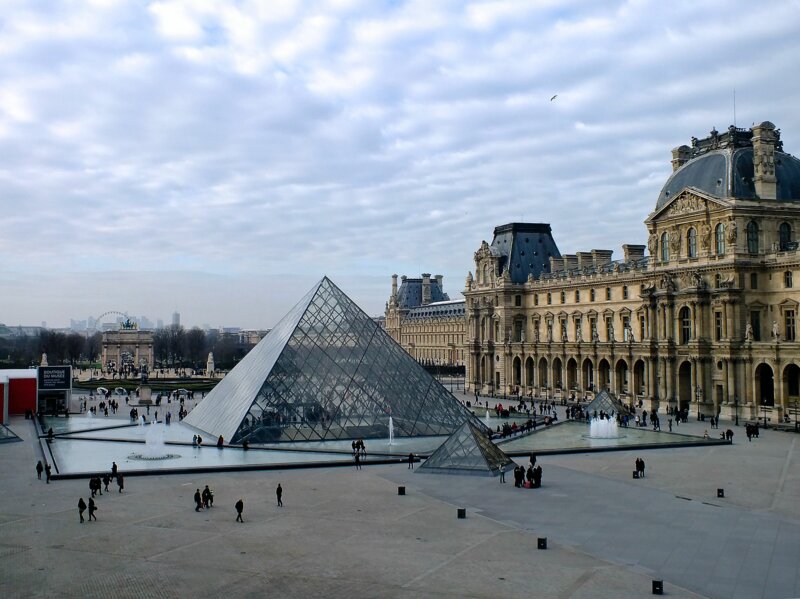
Three smaller pyramids flank the main pyramid. They were strategically placed to provide light shafts to access the museum’s collections.
When entering the Louvre through the Carrousel entrance, the inverted pyramid, also known as The Pyramide Inversée, is visible from underground. It’s an upside-down, suspended pyramid. It gives natural light to the Carrousel du Louvre shopping mall directly in front of the Louvre Museum.
See Related: Paris by Day 1h Tour in Vintage French Car
Mitterrand kicked out the Ministry of Finance from the building.
As part of the Grand Louvre, the French Finance Ministry was removed from the northern wing of the museum. This allowed room for the expansion and renovation of the Louvre.
It is featured in several movies.
The most famous movie that featured the Louvre Pyramid is Da Vinci Code. The film was based on a novel of the same title by Dan Brown, a mystery book centered on a murder inside the Louvre. Art pieces inside the Louvre museum are clues in the movies. Ultimately, the main character deciphers the final message, which implies that the Holy Grail has been buried beneath the small pyramid directly beneath the inverted pyramid in the Louvre.
Other movies that feature the Louvre Pyramid are The Red Notice (2021), Wonder Woman (2017), 2012 (2009), and Edge of Tomorrow (2014).
Related Sources:
- Best Hotels in Paris with Pools
- When is the Best Time to Visit Paris?
- Food Markets in Paris
- Best Weekend Trips from Paris, France